Can you sell vapes on Shopify? No. As of June 24, 2026, the Shopify vape ban means merchants selling Electronic Nicotine Delivery Systems, or ENDS, can no longer list those products on the platform.
Shopify sent notices to U.S. merchants requiring removal of every vape, e-liquid, vaporizer, and related accessory listing by July 7, 2026 UTC, or risk suspension.
Reuters confirmed the policy on July 10, and merchants who hadn’t complied by the deadline are now facing product delisting, account restrictions, or full store termination.
If you’re reading this because your store fell into that group, the priority is getting your data out and your storefront rebuilt somewhere that still allows the category.
This piece covers what the Shopify vape ban actually changed, how BigCommerce and Magento differ from Shopify on ENDS products, and what a realistic migration looks like.
Policy Update: What Shopify Changed and Why
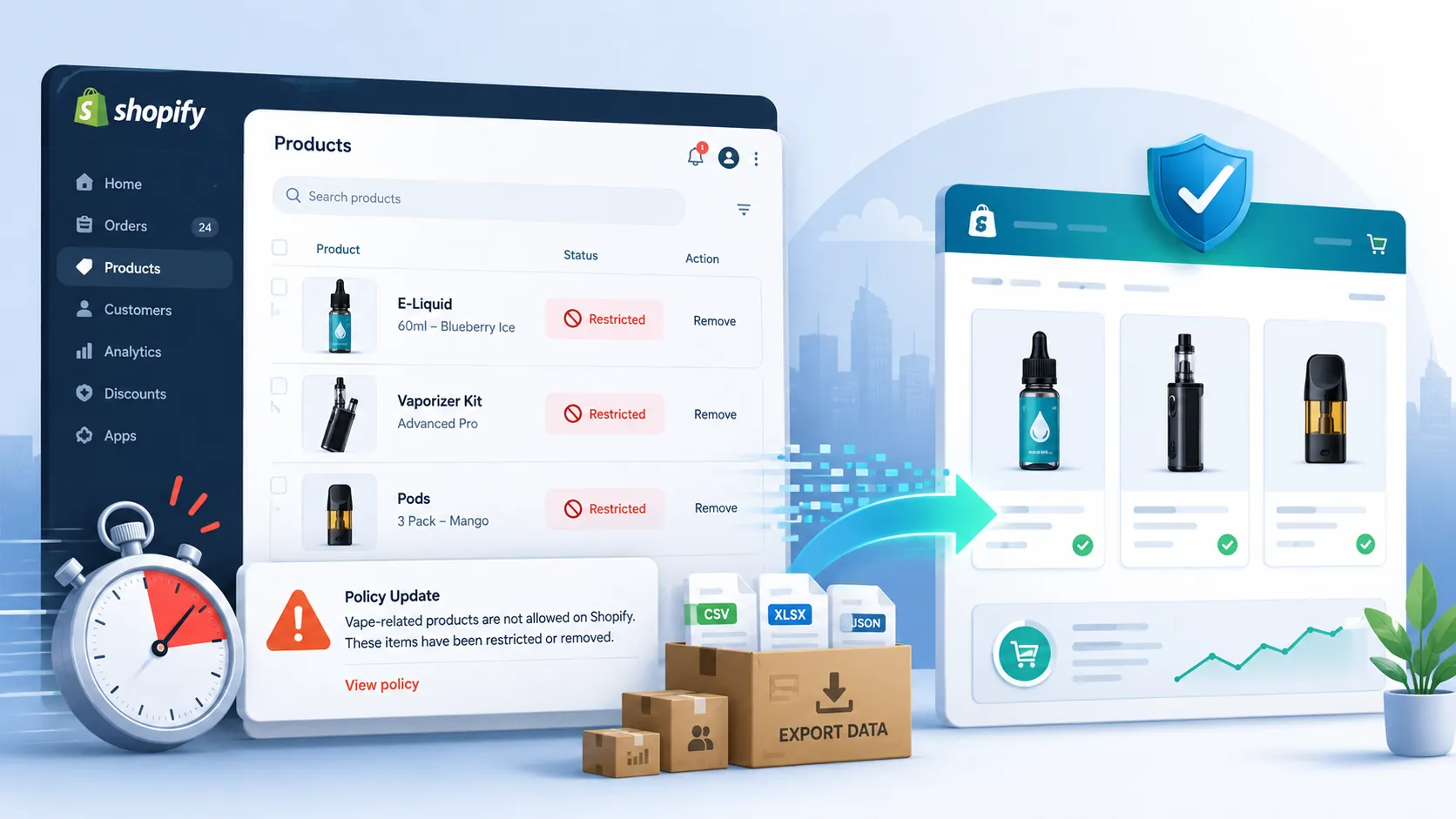
Shopify’s notice cited changes in legal restrictions on ENDS products as the reason it “no longer supports the sale of these products.” That single sentence covers e-cigarettes, e-liquids, vaporizers, replacement parts, and refills, regardless of nicotine content or FDA authorization status. In plain terms: whether you can still sell vapes on Shopify comes down to product category alone, not compliance history or authorization status.
When Does the Vape Ban Go Into Effect? Timeline & Deadline
- November 2025: A coalition of 25 attorneys general, led by Massachusetts AG Andrea Campbell and joined by states including California, New York, and Illinois plus the City of New York, sent Shopify a letter identifying 29 illegal e-cigarette websites and more than 200 additional tobacco-selling sites hosted on the platform.
- April 2026: California AG Rob Bonta led a separate multi-state effort aimed at the payment processors and financial intermediaries that made ENDS transactions possible in the first place, extending the pressure campaign beyond Shopify itself.
- June 24, 2026: Shopify begins sending individual merchant notices requiring ENDS product removal.
- July 7-8, 2026: Compliance deadline (UTC). Non-compliant stores face suspension.
- July 10, 2026: Reuters confirms the policy and Shopify’s spokesperson verifies the notices as authentic.
Truth Initiative research cited during the pressure campaign found that close to 90% of online e-cigarette stores running on Shopify failed at least one compliance check around age verification, shipping restrictions, or adult signature on delivery. That’s worth sitting with: the Shopify vape ban wasn’t purely a content policy call, it was also a response to pressure on the banking and card-network infrastructure every ecommerce platform depends on to collect money.
What the Ban Does and Doesn’t Cover
- FDA authorization doesn’t exempt you. Out of thousands of vape products on the market, the FDA has cleared only 45 (mostly tobacco-flavored), and Shopify’s notices apply to those alongside everything unauthorized.
- Appeals are technically available but unlikely to succeed if ENDS sales are your core business, since the policy is categorical rather than tied to individual violations.
- CBD-only merchants are not swept into this specific action. They remain under Shopify’s separate hemp and CBD compliance rules.
- A spokesperson for AG Bonta has said the decision applies globally, though Shopify itself hasn’t confirmed that. Reuters reportedly asked Shopify directly whether the ban extends beyond the U.S., and the company declined to answer. Enforcement so far is targeting U.S. merchants; treat international scope as unresolved rather than settled.
- This isn’t just the ~$9 billion illegal vape market British American Tobacco has estimated. Reporting from Token of Trust and 2Firsts both confirm the policy applies to the entire ENDS category, legal and illegal alike.
Two Details Every Affected Merchant Should Know
- Enforcement is happening through individual notices, not one public policy page. Not having received a notice yet doesn’t mean your store is clear.
- Shopify Plus merchants who received notices are reportedly being offered early contract exit without penalty. That tells you the company expects affected merchants to leave rather than adapt.
Shopify to BigCommerce Migration (and Magento): Platform Comparison & Your Options
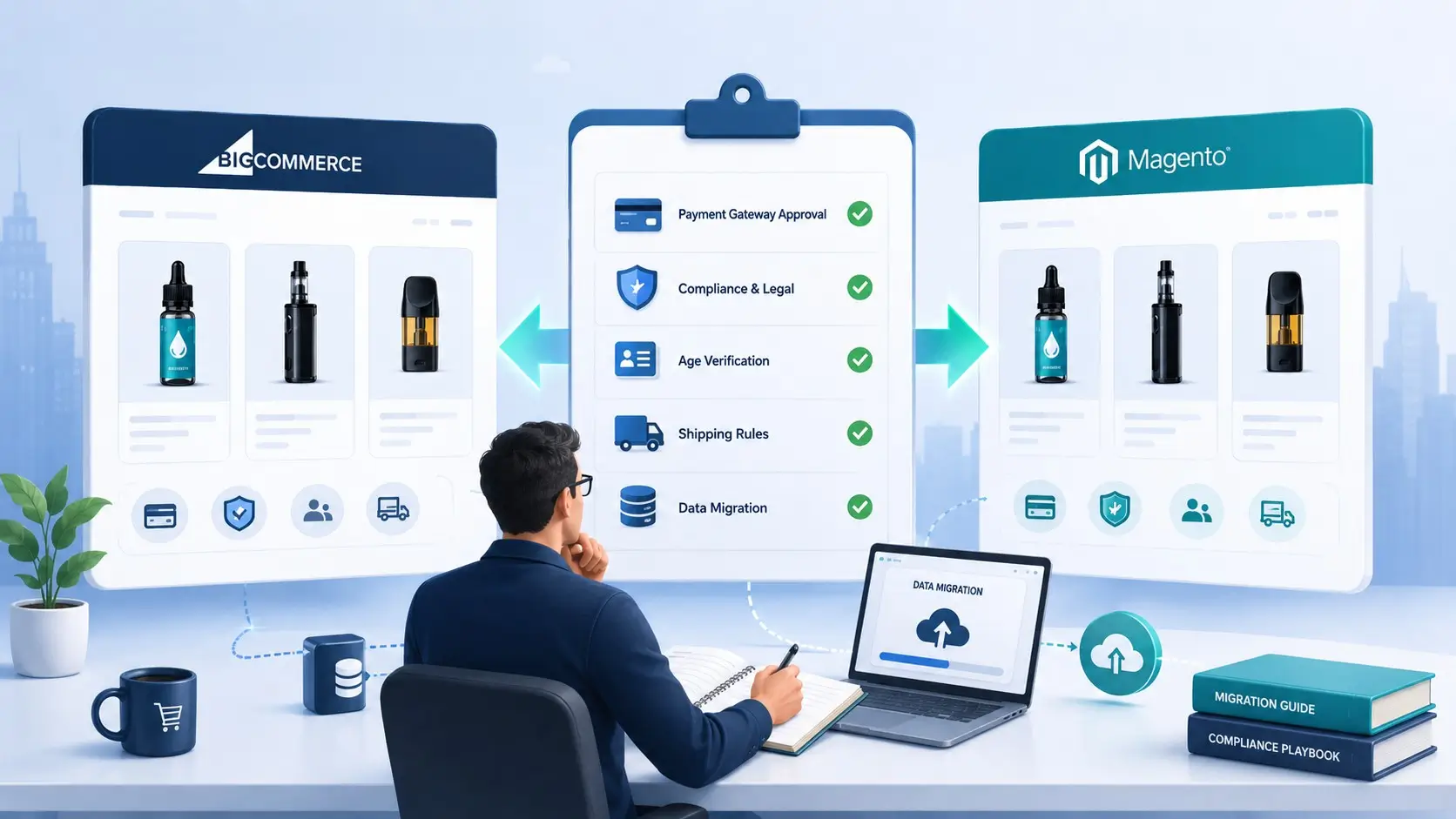
If you’re evaluating a Shopify to BigCommerce migration after the ban, or weighing Magento instead, here’s how the platforms compare on ENDS product policy, payment flexibility, and compliance customization.
The core question for anyone evaluating alternatives is simple: does the platform prohibit the category outright, or does it stay neutral and leave compliance to you and your payment processor? Shopify just moved from the second camp into the first. BigCommerce and Magento are still in the second.
| Dimension | Shopify | BigCommerce | Magento (Adobe Commerce) |
| ENDS/vape product policy | Platform-wide prohibition since June 24, 2026 | Not listed as a prohibited category | Not listed as a prohibited category |
| Who enforces it | Shopify, via account suspension | No platform-level product enforcement | No platform-level product enforcement |
| Hosting model | Fully managed SaaS | Fully managed SaaS | Self-hosted or Adobe-managed cloud |
| Payment model | Shopify Payments plus a limited set of approved gateways | Gateway-agnostic, ~65 integrations available | Merchant-integrated, fully open |
| Who owns compliance | Shared, but Shopify can override unilaterally | Merchant plus payment processor | Merchant plus payment processor |
| Precedent for a future category ban | Already happened | None currently | None currently, and harder to enforce given the self-hosted model |
BigCommerce: Payment-Agnostic, No Category Ban
- BigCommerce doesn’t list ENDS or e-cigarette products among its prohibited items, and its acceptable use policy is built around lawful use rather than product-category bans.
- The platform is payment-gateway agnostic, offering around 65 gateway integrations instead of bundling a single in-house processor the way Shopify does.
- Mechanically, that means a vape merchant connects a high-risk-friendly payment gateway like Authorize.Net or NMI to a matching high-risk merchant account, and the storefront itself has no built-in trigger for a category-wide takedown.
- The tradeoff: sourcing and maintaining that high-risk payment relationship is on you. If your processor drops high-risk accounts down the line, that’s a business continuity risk independent of the platform.
For the full mechanics of the switch, see our Shopify to BigCommerce migration checklist.
Magento: Self-Hosted Control, More Build Responsibility
- Magento, now sold as Adobe Commerce, is self-hosted, or run on Adobe’s managed cloud infrastructure, rather than a fully managed SaaS product like Shopify.
- There’s no central Magento payments division that can make a unilateral call to cut off a product category across every merchant in one week.
- You own the codebase, the checkout logic, and the integration choices, which means age-verification tooling, state-by-state shipping restrictions, and PACT Act tax reporting get built to your specification instead of squeezed into whatever a hosted checkout allows. The same logic applies to other age-restricted product categories that need custom compliance built into checkout rather than bolted on after.
- The tradeoff: more engineering overhead than a BigCommerce move, since you’re standing up and maintaining more of the stack yourself.
We don’t have a Shopify-to-Magento walkthrough live yet, but our Magento 2 data migration tool guide covers the underlying data migration mechanics, which hold regardless of source platform.
What Doesn’t Change No Matter Which Platform You Pick
- You’ll still need a processor willing to underwrite ENDS transactions.
- State-by-state PACT Act shipping compliance still applies.
- Age verification still needs to hold up to scrutiny.
What changes is that BigCommerce and Magento won’t independently decide your product category no longer fits their risk tolerance and give you seven days to prove otherwise.
BigCommerce vs. Magento: Which Fits Your Migration
| Factor | BigCommerce | Magento (Adobe Commerce) |
| Time to rebuild | Faster; managed platform, less to configure from scratch | Slower; more to build and test before launch |
| Engineering overhead | Lower; hosting, security patching, and uptime are handled for you | Higher; you or your dev team own more of the stack |
| Compliance customization | Configured through apps and gateway settings | Built to spec: custom age gates, geofencing, flavor rules by municipality |
| Payment gateway flexibility | ~65 built-in integrations, swap gateways without a rebuild | Fully open, but integration work is on you |
| B2B pricing alongside retail | Supported, but more constrained by the platform’s built-in logic | More flexible for complex tiered or contract pricing |
| Best fit | Merchants who need a compliant storefront live fast with standard compliance needs | Merchants with complex, state-by-state or product-line-specific compliance logic |
Migration Guide: Moving off Shopify Before You Lose Your Storefront
If your store is still live, this is the sequence that avoids losing data or search visibility mid-transition.
Before You Start
- Export everything now: full customer list, order history, product catalog, and theme or code assets, before any suspension takes effect. Self-service export tools can become unavailable once an account is locked, so this isn’t optional even if your store hasn’t been flagged yet.
- Check your domain setup: a domain registered externally and pointed at Shopify via DNS is straightforward to redirect elsewhere. A domain purchased directly through Shopify takes an extra transfer step, and that step gets harder once an account is restricted.
The Six-Step Migration Sequence
- Export your data. Catalog, customers, orders, and theme assets, in that priority order.
- Confirm domain ownership and transferability before you need to move fast.
- Pick the platform based on your actual constraints, not just which one allows the category. A fast, managed rebuild with minimal DevOps overhead points toward BigCommerce. Custom compliance logic, like state-specific age gates, flavor restrictions that vary by municipality, or B2B wholesale pricing alongside retail, points toward Magento’s open architecture.
- Line up your payment processor before you touch the storefront build. This step gets skipped because it feels administrative, but a finished store with no way to accept ENDS payments is an expensive brochure. High-risk merchant account approval can take longer than the storefront rebuild itself.
- Migrate data, then rebuild the front end, then cut DNS over last.
- Redirect every old URL to its new equivalent with 301s.
Common Mistakes That Cost Time
- Cutting over DNS before the new store and payment stack are tested. This is how merchants end up with orphaned orders or a broken checkout in front of live customers.
- Skipping the payment processor step until the storefront is built. High-risk approval timelines don’t compress just because your build is done.
- Not mapping redirects. A suspended Shopify storefront returns crawl errors to Google, and de-indexing can start within days to weeks. Mapping old product and category URLs to their new equivalents protects the search rankings you already built.
A migration started the moment you get a notice is faster and cleaner than one started in a panic after suspension. If you’re still in the window before enforcement hits your store, that’s the best time to move, not after the checkout is already broken.
How Folio3 Handles the Switch
The Shopify vape ban is forcing a lot of ENDS merchants through this exact process at once, and most of them are doing it for the first time.
We’ve run B2B platform migrations across Shopify, BigCommerce, WooCommerce, and Magento, including data-clean, SEO-preserving moves for merchants under time pressure.
One recent example: a sustainability-focused B2B brand, Eco-Products, migrated to BigCommerce and came out the other side with 50% lower total cost of ownership and 3x faster order completion, without losing existing product data or search rankings.
What We Handle
- Catalog and customer data migration without duplicate or corrupted records
- 301 redirect mapping so organic traffic survives the move
- Integration work for age-verification and high-risk payment tooling
- Platform selection scoped to your actual product mix and shipping footprint, not a generic template
Case Studies: Regulated Product Ecommerce
Vape isn’t the first age-restricted, compliance-heavy category we’ve built for. Three examples are directly relevant to what ENDS merchants are dealing with right now:
- Greenlane: A cannabis wholesale brand, needed PACT Act shipping enforcement built directly into checkout on BigCommerce. The result was a lower cart abandonment rate, proof that compliance logic and conversion aren’t a tradeoff when it’s built into the platform correctly the first time.
- Receptra: A CBD brand, migrated from Magento to BigCommerce with Folio3 and came away with reduced platform maintenance and faster load times, the same migration mechanics this guide walks through, already proven in a regulated-product context.
- Vapor: A CBD retail brand (the name is a coincidence, not a vape-product business), needed an ADA-compliant Shopify build with custom bundle logic. Folio3 improved the checkout flow and cut third-party app costs. Worth noting this one stayed on Shopify rather than migrating off it, so it speaks to our depth on regulated-retail builds generally, not to the migration case this guide is making.
Frequently Asked Questions
Does the Shopify Vape Ban Affect CBD-Only Stores?
No. CBD-only merchants remain under Shopify’s separate hemp and CBD compliance rules. This action targets ENDS and nicotine vape products specifically. The vape ban applies only to ENDS (Electronic Nicotine Delivery Systems) and nicotine products.
Can I Keep Selling Non-Vape Products on Shopify While I Migrate?
Yes. Splitting your catalog across two platforms during the transition, keeping non-vape SKUs on Shopify while you rebuild the ENDS side elsewhere, is common and workable, as long as the flagged products come down from Shopify to stay compliant with the notice.
What Happens to My Shopify Domain If My Store Gets Suspended?
It depends on where the domain is registered. A domain registered externally and pointed at Shopify via DNS is straightforward to redirect elsewhere. A domain purchased directly through Shopify takes an extra transfer step, and that step gets harder once an account is restricted.
Is the Shopify Vape Ban US-Only, or Does It Apply Globally?
Enforcement so far is targeting U.S. merchants. A spokesperson for AG Bonta has said the decision applies globally, but Shopify has reportedly declined to confirm that when asked directly, so treat international scope as unresolved rather than settled.
Can I Appeal If I Think My Products Are Compliant?
Appeals are technically available, but since the policy is categorical rather than tied to individual violations, they’re unlikely to succeed if ENDS sales are your core business, even for FDA-authorized products.
Can You Sell Vapes on Shopify in 2026?
No. As of June 24, 2026, the Shopify vape ban means ENDS and e-cigarette products cannot be listed on the platform, regardless of FDA authorization status or how long the store has been compliant.
When Does the Shopify Vape Ban Go Into Effect?
The vape ban went into effect on July 7-8, 2026 UTC, the compliance deadline Shopify set. Shopify began sending individual merchant notices on June 24, 2026, and stores that hadn’t removed ENDS listings by the deadline are now facing suspension or termination rather than a future cutoff.