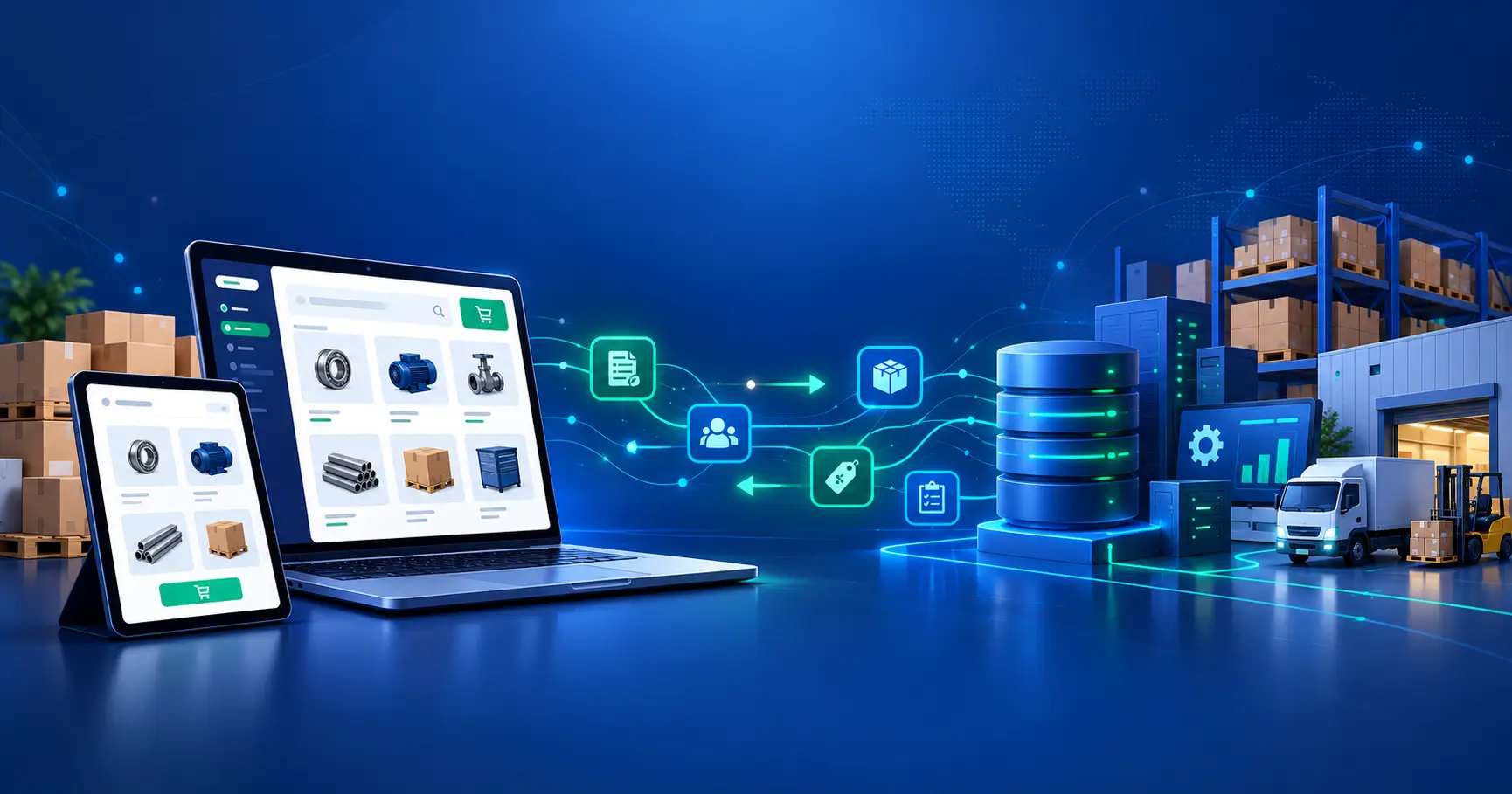
A B2B ecommerce development agency does far more than build a storefront. It connects your site to the ERP that holds your prices and stock, models company accounts and approval chains, and keeps orders accurate long after launch. Generic web developers usually discover this halfway through the project, when tiered pricing drifts out of sync with the ERP or a buyer portal breaks under multi-level accounts.
This guide compares 11 B2B ecommerce agencies, shows what each is genuinely best at, and gives you published cost and timeline ranges, a scorecard you can copy, and the questions that separate real B2B specialists from retail agencies with a B2B page. Disclosure: this guide is published by Folio3 eCommerce, and Folio3 is on the list. We explain exactly how the list was built so you can judge it yourself.
The short answer: which B2B ecommerce agency should you pick?
The best B2B ecommerce development agency depends on your ERP and platform. Folio3 eCommerce suits wholesalers, distributors and manufacturers that need ERP-connected commerce on Shopify Plus, BigCommerce or Adobe Commerce, with integrations for NetSuite, Microsoft Dynamics, SAP and custom ERPs. Web Solutions NYC suits ERP-heavy manufacturer and distributor builds on Adobe Commerce. Vaimo and BORN Group suit multi-region enterprise programs. Corevist and DCKAP fit SAP-based portals and integration-only projects.
If you only remember one rule: shortlist agencies that can name live clients running your ERP, and walk away from any that talk design before asking which ERP you use.
B2B ecommerce development agencies compared (2026)
The order below is editorial, not a score. Use the scorecard later in this guide to rank agencies against your own priorities. The descriptions are positioning summaries, so confirm specifics in reference calls.
| # | Agency | Type | Best for | Key platforms |
|---|---|---|---|---|
| 1 | Folio3 eCommerce | Full-service agency | Wholesalers, distributors and manufacturers needing ERP-connected B2B on Shopify Plus, BigCommerce or Adobe Commerce | Shopify Plus, BigCommerce, Adobe Commerce, Shopware |
| 2 | Web Solutions NYC | Full-service agency | ERP-first builds for US manufacturers and distributors | Adobe Commerce, Shopware |
| 3 | Atwix | Specialist agency | Adobe Commerce builds with large catalogs and ERP depth | Adobe Commerce |
| 4 | Classy Llama | Specialist agency | Integration-first Adobe Commerce for industrial sectors | Adobe Commerce |
| 5 | Magebit | Specialist agency | Complex catalogs, product configuration, dealer networks | Adobe Commerce, Hyvä |
| 6 | Vaimo | Large multi-region agency | Multi-region programs blending B2B and DTC | Adobe Commerce, Shopify Plus, BigCommerce |
| 7 | Object Edge | Consultancy | CPQ-heavy and composable (MACH) B2B | commercetools, Oracle Commerce and CPQ, Salesforce |
| 8 | Codal | Specialist agency | BigCommerce B2B Edition and UX-led sales portals | BigCommerce, Shopify Plus |
| 9 | Corevist | Managed portal platform | Manufacturers running SAP ERP | Corevist platform on SAP ERP |
| 10 | DCKAP | Integration platform (iPaaS) | ERP-to-commerce integration for distributors | DCKAP Integrator |
| 11 | BORN Group | Enterprise integrator | Global enterprise programs on SAP Commerce Cloud and Salesforce | SAP Commerce Cloud, Salesforce, Adobe Commerce |
Need an ERP-connected B2B store, not just a storefront?
Share your ERP and platform and the Folio3 eCommerce team will map the integration and scope the build.
How we chose these B2B ecommerce agencies
This list is published by Folio3, so here is the method, stated plainly. We drew on public information, review platforms, platform partner programs and our own market experience, and included agencies that show real B2B work rather than retail storefronts. We deliberately mixed three types of firm, because buyers genuinely choose between them: full implementation agencies, productized specialists (Corevist for SAP portals, DCKAP for integration), and enterprise system integrators.
Every agency was assessed against the same six questions:
-
B2B features actually shipped: account hierarchies, contract pricing, quote-to-order, credit terms, quick order.
-
ERP integration record: named systems such as SAP, NetSuite, Microsoft Dynamics, Epicor and Infor.
-
Platform coverage: depth on Adobe Commerce, Shopify Plus, BigCommerce, Salesforce, SAP Commerce Cloud and composable stacks.
-
Procurement integration: PunchOut (cXML or OCI) and EDI for enterprise buyers.
-
Independent validation: verified reviews, partner tiers, certifications.
-
Delivery and support: discovery, QA, staging and post-launch governance.
What disqualifies an agency: a B2C-only track record, no documented ERP integration work, or validation limited to self-published case studies. Treat every claim in this guide, including ours, as a starting point for reference calls.
What a B2B ecommerce development agency actually does
A B2B ecommerce development agency designs, builds and integrates online ordering systems for manufacturers, wholesalers and distributors. Unlike a retail agency, it works against four hard constraints: contract pricing that resolves from an ERP, company accounts with multiple buyers and approval limits, reordering built around saved lists and part numbers, and a live two-way connection to the system that holds real inventory and orders. Most B2B projects are hired for the integration, not the storefront design.
How B2B differs from B2C
B2C sells one price to one shopper who pays at checkout. B2B sells negotiated prices to organizations, often with credit terms, purchase-order numbers, volume breaks and approvals before an order reaches the ERP. Prices, catalogs and payment terms change per customer. An agency that mostly ships B2C storefronts typically underestimates this logic, and the gap shows up as wrong prices, stalled approvals and manual re-keying after launch.
Why buyers now expect self-service
Gartner’s March 2026 survey of 646 B2B buyers found that 67% prefer a rep-free buying experience. Forrester’s State of Business Buying 2026 found the typical purchase involves 13 internal stakeholders and nine external influencers. Together these explain why portals now need self-serve quoting, shared accounts with role-based permissions and visible approval histories rather than a login that only shows a catalog.
Core capabilities to look for
-
ERP, PIM, CRM and OMS integration with retries, duplicate prevention and monitoring, so a failed message never becomes a wrong price or duplicate order.
-
Contract and customer-specific pricing that comes from the ERP and is re-checked at checkout.
-
Company accounts, roles and approval chains that mirror how your customers actually buy.
-
Quote and RFQ workflows where an approved quote converts directly into an ERP order.
-
PunchOut and EDI for buyers who purchase through Coupa, SAP Ariba or similar systems.
-
Quick order and reorder tools: saved lists, CSV upload, order-history reorder.
-
Credit, tax and shipping logic: net terms, tax exemptions, freight rules.
-
Post-launch monitoring of ERP sync, speed and catalog data quality.
The 11 best B2B ecommerce development agencies in 2026
Each profile follows the same template: who they are, what they are best for and an honest limitation. These are positioning summaries, so confirm specifics in reference calls.
1. Folio3 eCommerce
Best for: mid-market and growth-stage manufacturers, wholesalers, distributors and hybrid B2B plus D2C brands that want ERP-connected commerce on Shopify Plus, BigCommerce or Adobe Commerce.
Folio3 is a Silicon Valley-based digital transformation company with 15+ years in ecommerce and 12+ years building B2B commerce, with offices across North America, the UK, the Middle East and Pakistan. It builds on Shopify Plus, BigCommerce and Adobe Commerce, and integrates with NetSuite, Microsoft Dynamics, SAP and custom ERPs, with bidirectional sync for orders, customers, inventory and pricing. It is a Shopify Plus, BigCommerce, Magento and Shopware partner, a NetSuite Alliance Partner and a Microsoft Dynamics 365 partner. It also publishes ready-made B2B modules for quoting and negotiation, credit account ledgers, self-serve account management, Avalara tax compliance and sales-rep mobile ordering.
Folio3 B2B ecommerce case studies
-
Burch Bottle: migrated from NetSuite SuiteCommerce Advanced to BigCommerce Enterprise with B2B Edition, a custom gated registration and buyer portal, Avalara tax exemptions and 100,000+ historical records moved at 99.9% accuracy, with operating costs down 15%.
-
EcoProducts: replatformed to BigCommerce with custom middleware that reconciles single-unit, pack and case inventory with NetSuite, plus automated order splitting, a customer-group B2B app and US and Canada multi-storefronts.
-
Easilocks: a unified B2B and B2C platform on Shopify Plus, reporting 20% conversion growth and 30% lower operating costs.
Limitation: Folio3’s published ERP case evidence leans toward NetSuite on BigCommerce and Shopify Plus, so buyers on SAP-heavy or multinational enterprise estates should ask for references on their specific ERP.
2. Web Solutions NYC
Best for: US manufacturers and distributors whose project is really an ERP integration project.
Web Solutions NYC is a New York agency that focuses on ERP-first B2B builds for manufacturers and distributors, mainly on Adobe Commerce and Shopware. Buyers with NetSuite, SAP, Microsoft Dynamics or Epicor estates should ask for references on their specific system.
Limitation: best suited to established mid-market and enterprise projects rather than startups, template builds or price-led buying.
Already on Shopify Plus, BigCommerce or Adobe Commerce?
Folio3 builds ERP-connected B2B portals on all three. Tell us your stack and we will outline the approach.
3. Atwix
Best for: Adobe Commerce builds with large catalogs and serious ERP engineering.
Atwix is an Adobe Commerce specialist known for ERP integration work and large-catalog builds. It is a natural shortlist candidate for manufacturers committed to Adobe Commerce who need deep engineering.
Limitation: strongly Adobe Commerce-centric, so it is less suited to buyers who want platform-agnostic selection help first.
4. Classy Llama
Best for: manufacturers and distributors that want an integration-first Adobe Commerce partner.
Classy Llama is a US Adobe Commerce agency that leads with connecting the ERP, PIM, CRM, payments and tax to the storefront, with experience in manufacturing, distribution, agriculture and automotive. It suits manufacturers and distributors that want an integration-first approach.
Limitation: Adobe Commerce focus; teams on Shopify Plus or BigCommerce should look elsewhere on this list.
5. Magebit
Best for: complex B2B catalogs, custom product configuration and dealer or sales-rep workflows.
Magebit is a Riga-based Adobe Commerce specialist focused on complex catalogs, custom product configuration and performance-focused Hyvä frontends, with ERP-driven pricing and dealer workflows.
Limitation: better suited to established merchants with complex requirements than to simple, low-cost B2B stores.
6. Vaimo
Best for: multi-region programs where a wholesale channel and a consumer channel run side by side.
Vaimo is a long-established Adobe Commerce agency with a multi-region footprint. Its B2B practice covers contract pricing, PunchOut integrations and approval workflows, with managed services after launch.
Limitation: scale can work against single-region, mid-market projects, and ERP-centric manufacturer scope is one practice among several.
7. Object Edge
Best for: CPQ-heavy and composable B2B where product data, pricing logic and configuration drive the build.
Object Edge is a US consultancy focused on configure-price-quote, subscription commerce, PIM and composable architectures, working with Oracle, commercetools and Salesforce. It fits manufacturers whose catalogs and quoting logic outgrow packaged storefronts.
Limitation: a focused senior consultancy, so the model can feel heavy for a fast packaged-platform storefront with light integration.
8. Codal
Best for: BigCommerce B2B Edition builds and UX-led B2B sales portals.
Codal is a Chicago-based UX and engineering agency, named 2021 BigCommerce Agency Partner of the Year for the Americas. Its B2B work centers on quick-order interfaces, rep-assisted ordering and system integrations for distributors and wholesalers.
Limitation: strongest within BigCommerce and Shopify, so Adobe Commerce or SAP-anchored enterprises should look further up the list.
9. Corevist
Best for: manufacturers running SAP ERP that want a customer ordering portal live in months.
Corevist is a managed B2B portal platform rather than a traditional agency, built for manufacturers running SAP ERP with prebuilt real-time SAP integration.
Limitation: you buy their platform and roadmap, not a custom build, and it is not built for manufacturers on other ERPs or those needing deep storefront customization.
10. DCKAP
Best for: distributors whose pain is data flow between ERP, commerce, CRM, PIM and EDI rather than the storefront.
DCKAP’s core product, DCKAP Integrator, is an iPaaS built for distributors that automates the flow of order, inventory, pricing and customer data between ERP, commerce, CRM, PIM and EDI systems.
Limitation: an integration layer, not a ground-up storefront build, so you still need a design-and-build partner.
11. BORN Group
Best for: global enterprise programs on SAP Commerce Cloud and composable Salesforce.
BORN Group is part of Tech Mahindra and runs SAP Commerce and Salesforce practices alongside Adobe Commerce, backed by a global delivery bench.
Limitation: enterprise-SI economics and cadence, so mid-market buyers often get more senior attention per dollar from a focused B2B specialist.
Want to see how Folio3 would scope your B2B build?
Tell us about your catalog, buyer roles and ERP. We will come back with a clear plan and next steps.
Which B2B ecommerce agency fits your scenario?
Use these scenarios to test fit. They are not additional rankings.
| Your scenario | What to verify | Agencies to shortlist |
|---|---|---|
| ERP-integrated manufacturer portal | Live integration with your exact ERP for pricing and inventory | Folio3 eCommerce, Web Solutions NYC, Atwix, Classy Llama |
| Wholesale or distributor ordering with contract pricing | Customer-specific price lists, credit terms, quick reorder | Folio3 eCommerce, Codal, Web Solutions NYC |
| SAP-based manufacturer wanting speed | Prebuilt SAP integration and timeline | Corevist, BORN Group |
| Dealer network and B2B2C | Dealer-specific catalogs and pricing, sales-rep ordering | Folio3 eCommerce, Magebit, Vaimo |
| Quote-to-order and CPQ | A live quote flow that converts into an ERP order | Folio3 eCommerce, Object Edge |
| PunchOut and EDI procurement | A shipped cXML or OCI integration with a reference client | Vaimo, Object Edge |
| Hybrid B2B plus D2C on one platform | Separate pricing and catalogs without cross-contamination | Folio3 eCommerce, Vaimo |
| Multi-region enterprise | Multi-ERP, localized tax, phased rollout | Vaimo, BORN Group |
| Data flow problem, storefront already fine | Middleware or iPaaS fit | Folio3 eCommerce, DCKAP |
| Composable or headless | MACH architecture experience | Folio3 eCommerce (headless commerce), Object Edge |
B2B ecommerce agency vs. freelance developers vs. in-house team
Many buyers weigh hiring B2B ecommerce developers directly before approaching an agency. The right choice depends on integration risk, not just budget.
| Agency | Freelance B2B ecommerce developer | In-house team | |
|---|---|---|---|
| Best for | Full B2B builds with ERP integration | Small, well-defined tasks and extensions | Long-term, continuous roadmaps |
| Integration capability | Cross-functional: architect, developers, QA, PM | Depends heavily on the individual | Strong once built; slow to assemble |
| Speed to start | Weeks | Days | Months (hiring) |
| Delivery risk | Shared across a team | Concentrated in one person | Concentrated in hiring and retention |
| Post-launch support | Retainer or SLA | Ad hoc | Built in |
| Cost profile | Project or retainer pricing | Lowest hourly rates | Highest fixed cost |
A practical middle path is a dedicated developer or team from an agency. Folio3, for example, offers fixed-cost projects, dedicated developers and build-your-own-team models, so you can start with a fixed-scope build and later move to a dedicated team for ongoing work.
Rule of thumb: use freelance developers for self-contained tasks, an agency for the initial build and ERP integration, and in-house engineers once the platform is stable and the roadmap is continuous.
Which platform needs which agency skills?
Choosing the platform is only half the decision. The other half is finding a team that has implemented B2B functionality on that platform in production.
| Platform | Best fit | Native B2B features | Agency skill to verify |
|---|---|---|---|
| Adobe Commerce | Complex catalogs, tiered pricing, custom logic | Company accounts, shared catalogs, negotiable quotes, purchase order approvals, requisition lists | Extension governance, performance, ERP architecture |
| Shopify B2B (Plus adds extras such as customer-specific deposits) | Mid-market, fast time-to-value, hybrid B2B and D2C | Company accounts, catalogs and price lists, net payment terms, quantity rules | Custom apps, ERP middleware, headless |
| BigCommerce B2B Edition | Mid-market with moderate catalog complexity | Open-source buyer portal, company accounts, sales rep masquerade, invoice portal, quotes | Multi-storefront, ERP connectors, headless |
| SAP Commerce Cloud | Enterprises already on SAP ERP | Full B2B suite, tight SAP integration | Enterprise program delivery |
| Salesforce B2B Commerce | Salesforce CRM-centric organizations | CRM-native accounts and orders | Salesforce architecture |
| Composable (commercetools and similar) | Strong in-house engineering, bespoke needs | API-first flexibility | MACH architecture |
Confirm current capabilities on each platform’s own documentation before you commit, since B2B feature sets change quickly.
What B2B ecommerce development services typically include
Scope varies, but a complete engagement usually covers discovery and ERP audit, storefront and buyer-portal build, pricing and catalog logic, ERP, PIM, CRM and OMS integration, data and platform migration with SEO preservation, QA and UAT, and post-launch support. Folio3’s own B2B ecommerce development services follow this shape, from storefront and custom portals to PunchOut, bulk ordering, quick reorder and request-for-quote.
How much does a B2B ecommerce development agency cost?
Costs depend mainly on platform, number of ERPs, pricing complexity and procurement integrations. The ranges below combine Folio3’s published guidance with third-party cost guides, so treat them as indicative and ask for a scoped quote.
| Project type | Range | Source |
|---|---|---|
| B2B ecommerce solution with custom pricing, bulk ordering, payment terms and ERP integration | $120,000 to $220,000 | Monocubed |
| Advanced B2B platform | $75,000 to $150,000 | Yo-Kart |
| Enterprise B2B platform | $150,000 to $500,000+ | Yo-Kart |
| Complex or enterprise ecommerce build (all types) | $80,000 to $250,000+ | BigCommerce |
| ERP integration only, mid-market ERP (NetSuite, Dynamics) | $15,000 to $45,000 | Monocubed |
| ERP integration only, enterprise ERP (SAP, Oracle) | $25,000 to $70,000 | Monocubed |
Ranges differ because each source defines scope differently and serves a different client mix. A “standard storefront” in one guide may exclude the CPQ, PunchOut or multi-ERP work another includes.
What pushes cost up
-
ERP connections. Custom sync logic is especially expensive when the ERP is the source of truth for pricing, inventory and customers.
-
Pricing complexity. Tiered, contract-specific and account-based rules multiply testing.
-
Procurement integrations. PunchOut and EDI need setup and testing across external systems.
-
Migration. Historical orders, customers and invoices must be moved and validated.
Hidden costs buyers miss
-
ERP sync maintenance after ERP updates and API changes.
-
Catalog and PIM upkeep to keep products, prices and stock aligned.
-
A post-launch retainer for new accounts, features and monitoring.
Get a scoped quote, not a generic price range
Cost depends on ERP count, pricing rules and PunchOut. Send us your requirements for a quote built around them.
How long does a B2B ecommerce build take?
Folio3’s published guidance for a standard B2B build is 8 to 12 weeks from discovery to go-live, covering about two weeks of discovery, four to six weeks of development and two weeks of testing. ERP integrations, CPQ and heavy customization take longer: third-party guides put B2B ecommerce builds with ERP integration at roughly 5 to 8 months and enterprise B2B platforms at 8 to 18+ months.
| Phase | What happens | Typical duration |
|---|---|---|
| Discovery and scoping | ERP audit, pricing rules, buyer roles, acceptance criteria | About 2 weeks for a standard scope; longer with multiple ERPs |
| Design and build | Storefront, portal, account structure, pricing logic | 4 to 6 weeks for a standard scope |
| Integration and data migration | ERP, PIM, CRM sync; historical data | Runs alongside the build; extends with ERP complexity |
| Testing and UAT | End-to-end orders, partial orders, failure handling | About 2 weeks |
| Launch and hypercare | Go-live, monitoring, fixes | Days to weeks |
The biggest schedule risk is usually data quality: catalog, customer master and price-list debt are a common cause of overruns, and one B2B build benchmark plans 3 to 5 weeks just to clean and structure product and price data before development starts. Ask how discovery surfaces it before contracting.
A scorecard you can copy to compare any agency
Score each shortlisted agency from 1 to 5 on each row, multiply by the weight, and compare totals. Adjust the weights to your situation.
| Criterion | Weight | What to check |
|---|---|---|
| ERP integration proof | 25% | Reference on your exact ERP; bidirectional sync in production |
| B2B feature depth | 20% | Contract pricing, account hierarchies, quote-to-order, credit terms |
| Platform fit | 15% | Delivered B2B builds on your shortlisted platform |
| PunchOut and EDI | 10% | Live cXML or OCI integration with a named procurement system |
| Independent validation | 10% | Verified reviews, partner tiers, reference calls |
| Delivery governance | 10% | Discovery, staging, QA, escalation model |
| Post-launch support | 10% | SLA, roadmap cadence, whether the senior team stays |
8 questions to ask before you sign any B2B ecommerce agency
-
Which live clients run our ERP? Ask for a reference on your exact system, not a generic claim that they integrate with ERPs.
-
Show contract pricing sync in production. Customer-specific prices, tiers and negotiated terms flowing from the ERP, including edge cases.
-
Walk me through a shipped PunchOut or EDI integration. Which procurement systems, and how orders re-enter the buyer’s approval chain.
-
How do you model account hierarchies? Parent-child accounts, roles, budgets and multi-step approvals on the platform you propose.
-
What does quote-to-order look like? RFQ intake, rep-assisted quoting and conversion to an ERP order.
-
What is your staging, QA and escalation model? Gaps here surface as silent failures on credit checks and EDI exceptions.
-
Who owns the code, and what are the exit terms? Clarify intellectual property, documentation and handover if you change partners.
-
What happens after launch? Support SLAs, who owns catalog and pricing rules, and whether the scoping team stays on the program.
Want an agency that answers these 8 questions clearly?
Put them to Folio3 first. We will walk you through ERP-specific references, project scope and the delivery plan.
Red flags when choosing a B2B ecommerce development company
These do not automatically rule out an agency, but each deserves a direct answer.
-
A portfolio of beauty, apparel or DTC brands with no B2B or ERP case studies.
-
Design and branding pitched before anyone asks which ERP you run.
-
“We integrate with anything” with no named systems or project counts.
-
A fixed price quoted before anyone has examined your ERP customizations.
-
No named developer for your integration, and no honest stories about projects that went wrong.
-
Proposals that spend most of the budget on design and front end instead of integration and data.
Two or more red flags means keep looking, even if the agency appears on a list like this one.
How to prepare your brief before requesting proposals
Document your current platform, required integrations, buyer roles, pricing rules and the operational problems the new site must solve. Separate launch essentials from phase-two features and include measurable acceptance criteria, so every agency estimates the same work. Give each shortlisted agency the same four test scenarios: an account with negotiated prices, a buyer requesting a quote, a repeat order with changing stock, and an order that needs approval before it reaches the ERP. Ask each to explain how it would build and test them.
Frequently asked questions
What does a B2B ecommerce development agency do?
It designs, builds and integrates online ordering systems for manufacturers, wholesalers and distributors. That includes the storefront and buyer portal, contract pricing, account hierarchies and approvals, quoting, and two-way integration with ERP, PIM and CRM systems, plus ongoing support after launch.
How do I choose a B2B ecommerce developer or agency?
Shortlist teams with live integrations on your ERP and delivered builds on your platform. Compare proposals against the same scope and test scenarios, check verified reviews and partner tiers, run reference calls, and confirm who owns integrations, testing and support after launch.
How much does B2B ecommerce development cost?
Folio3’s entry point for a standard B2B storefront with ERP integration sits below the third-party ranges in this section, and a scoped quote gives exact figures for your ERP and catalog. Third-party guides cite $120,000 to $220,000 for B2B solutions with custom pricing and ERP integration, and $150,000 to $500,000+ for enterprise platforms. ERP count, pricing rules and PunchOut drive most of the difference.
How long does a B2B ecommerce build take?
A standard build can take 8 to 12 weeks, according to Folio3. Third-party guides cite 5 to 8 months for B2B builds with ERP integration and 8 to 18+ months for enterprise programs, because integration mapping and data quality take longer than the storefront.
Which platform is best for B2B ecommerce?
There is no single best. Adobe Commerce suits complex catalogs and custom logic, Shopify Plus suits fast launches and hybrid B2B and D2C, BigCommerce B2B Edition suits mid-market buyer portals, and SAP Commerce Cloud or Salesforce suit enterprises already on those stacks. Match the platform to your ERP and catalog.
Should I hire an agency, freelance developers or an in-house team?
Use an agency for the initial build and ERP integration, where cross-functional skills reduce risk. Freelancers suit small, well-defined tasks. In-house engineers make sense once the platform is stable and you have a continuous roadmap.
What is PunchOut in B2B ecommerce?
PunchOut lets a buyer’s procurement system, such as Coupa or SAP Ariba, open your catalog inside its own purchasing workflow, usually through cXML or OCI. Orders flow back into the buyer’s approval chain. It is common scope for suppliers selling to large enterprises.
How is B2B ecommerce development different from B2C?
B2B builds are contract-driven and ERP-synchronized. They need company accounts, customer-specific pricing, approvals, quoting, credit terms and procurement integrations, whereas B2C centers on a single shopper, public pricing and a simple checkout.
Final thoughts: shortlist on proof, not promises
The right B2B ecommerce agency is the one that can show your ERP, your platform and your buying scenarios running in production for someone else. Use the scorecard, ask the eight questions, and treat every number in this guide, including ours, as a starting point for reference calls.
If you want to talk through your own scope, Folio3’s team can map your ERP integration, platform options and timeline, including when another partner on this list is the better fit. Explore our B2B ecommerce development services or book a discovery call.
Ready to shortlist on proof, not promises?
Ask us for ERP-specific references and a walkthrough of a live B2B build before you decide.