


Yes. Shopify can support highly customizable products and dynamic pricing, but complex configurations often require custom development beyond Shopify’s standard product and variant model.
When a product’s final price depends on multiple customer selections such as dimensions, fabric, lining, style, and additional options creating every possible combination as a Shopify variant can become difficult to manage and maintain.
A scalable approach is to use Shopify as the core commerce platform while implementing a custom product configuration and pricing layer to manage complex business rules.
The Half Price Drapes implementation demonstrates how this approach can be used to support customizable window-treatment products with dynamic pricing, configuration rules, inventory synchronization, and custom administration.
Key Considerations
Product Configuration
Complex products may have multiple dependent attributes, including:
- Size
- Fabric
- Lining
- Style
- Mounting options
- Additional accessories
- Custom measurements
The number of possible combinations can quickly become too large to manage efficiently as individual Shopify variants.
Dynamic Pricing
For made-to-order products, the final price may depend on several selections.
For example:
Final Price = Size + Fabric + Lining + Style + Additional Options
A dynamic pricing engine can calculate the appropriate price based on the customer’s configuration rather than requiring a separate Shopify variant for every possible combination.
Configuration Rules
Some product options may depend on other selections.
For example:
- Certain fabrics may only be available with specific linings.
- Certain sizes may have different pricing rules.
- Some options may only be available for particular product styles.
These relationships need to be validated before the customer adds the product to the cart.
Inventory Management
Customizable products may depend on underlying component inventory.
For example, multiple curtain configurations may use the same fabric SKU. The system therefore needs to maintain the relationship between the configurable product and the underlying inventory.
Cart and Checkout
The customer’s selected configuration and calculated price must be correctly transferred from the product page into the cart and ultimately into the order.
This becomes particularly important when the final product is generated from multiple customer selections rather than a standard Shopify variant.
Administration
Pricing rules, product relationships, fabrics, attributes, and configuration rules may change frequently.
A custom administration interface can allow merchandising and operations teams to manage these rules without requiring developers to modify application code for every change.
Scalability
The architecture should avoid creating thousands of individual variants simply to represent every possible combination.
Instead, configuration and pricing logic can be handled through a dedicated application or service while Shopify remains responsible for the core commerce experience.
What Shopify Supports
Shopify provides native product and variant functionality for representing different versions of a product. Shopify also provides APIs, metafields, app extensions, and other development capabilities that allow merchants to extend the standard commerce experience.
For products with relatively simple options and pricing structures, Shopify’s native functionality may be sufficient.
However, when pricing and product availability depend on multiple interconnected configuration rules, custom application logic may be required.
Shopify’s platform allows developers to build this additional functionality around the core storefront, cart, checkout, and order-management experience.
Relevant Shopify capabilities include:
- Products and variants
- Metafields
- Storefront APIs
- Admin APIs
- Shopify Functions
- Cart Transform capabilities
- Webhooks
- Custom apps
- Checkout and UI extensions
These capabilities allow Shopify to remain the commerce platform while specialized business logic is handled through custom development.
What Usually Requires Custom Development
Custom Product Configuration
A custom configurator can provide customers with a guided interface for selecting dimensions, materials, styles, and other options.
The configurator can also control which combinations are valid.
Dynamic Pricing Engine
A custom pricing engine can calculate the product price based on the customer’s selections.
For example:
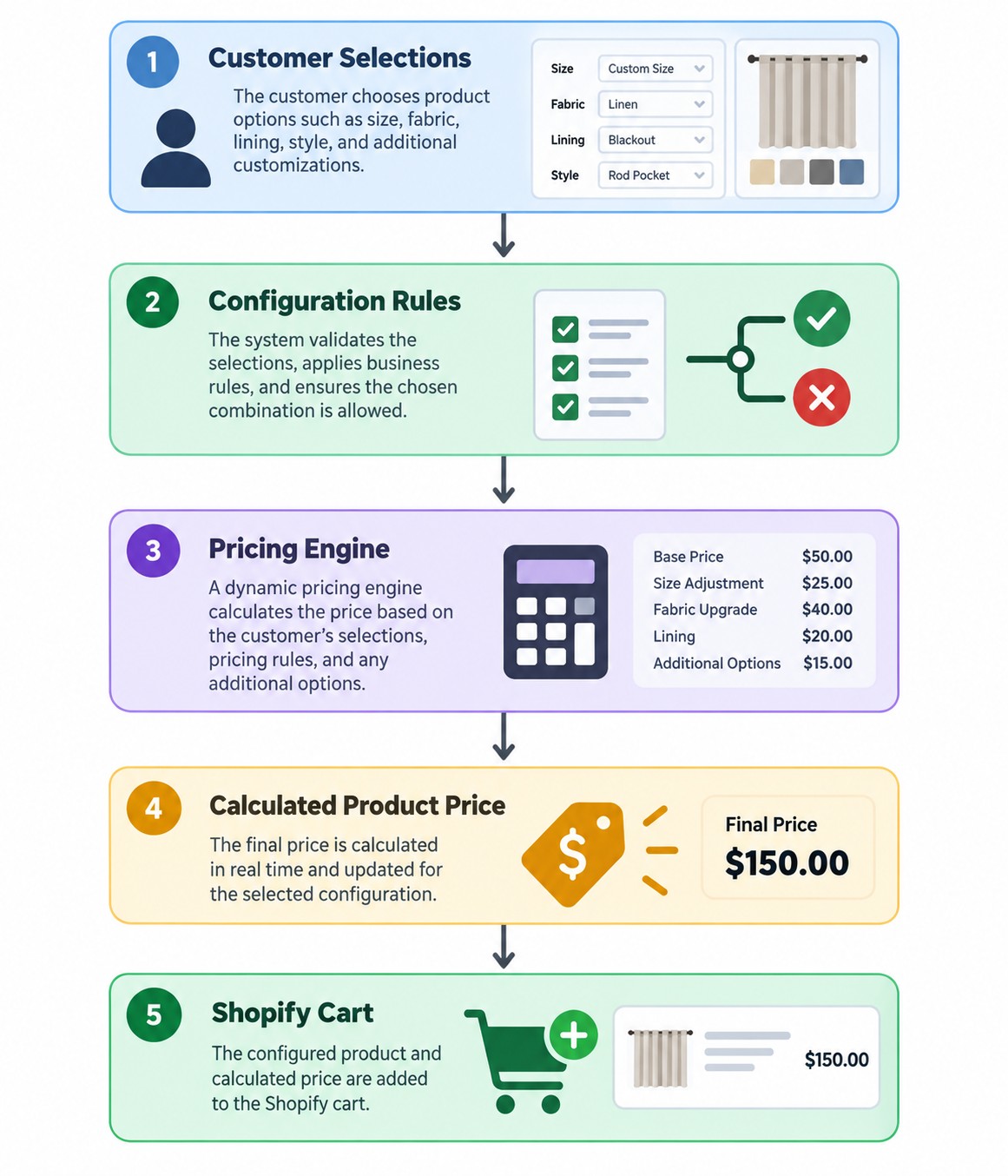
This approach is more flexible than maintaining a separate Shopify variant for every possible combination.
Cart Transformation
When a configuration needs to be represented differently in Shopify’s cart, custom cart transformation logic can be used to ensure that the configured product and its pricing are correctly represented.
Inventory Synchronization
A custom integration can synchronize underlying material or component inventory with configurable products.
For example:
Custom Administration
A custom admin interface can allow business users to manage:
- Pricing tables
- Size rules
- Fabric mappings
- Product relationships
- Attribute combinations
- Configuration rules
This reduces dependency on developers for routine merchandising and pricing updates.
Half Price Drapes Case Study
Half Price Drapes offers customizable window-treatment products where customers can select different attributes and specifications.
The existing implementation faced challenges around complex pricing, product configuration, inventory relationships, and maintaining the underlying business rules.
The solution introduced a custom configuration and pricing architecture designed specifically for these requirements.
Dynamic Pricing Engine
A JavaScript-driven pricing engine calculates pricing based on the customer’s selected attributes and dimensions.
This allows customers to see pricing changes as they modify their configuration.
Custom Shopify Application
A custom Shopify application centralizes configuration rules and pricing information.
The application provides a structured way to manage the relationships between products, attributes, fabrics, sizes, and pricing rules.
Cart Transformation
Shopify’s Cart Transform capabilities are used to ensure that customized product configurations are correctly represented in the cart.
Inventory Synchronization
Webhook-based synchronization connects fabric inventory with the relevant configurable products.
This helps maintain accurate inventory relationships when the same underlying fabric or component is used across multiple product configurations.
Custom Administration Interface
A custom admin interface allows business users to manage configuration and pricing information without requiring developers to manually update application logic for every change.
This architecture allows the storefront to provide a flexible product customization experience while keeping the underlying configuration and pricing rules centrally managed.
Recommended Architecture
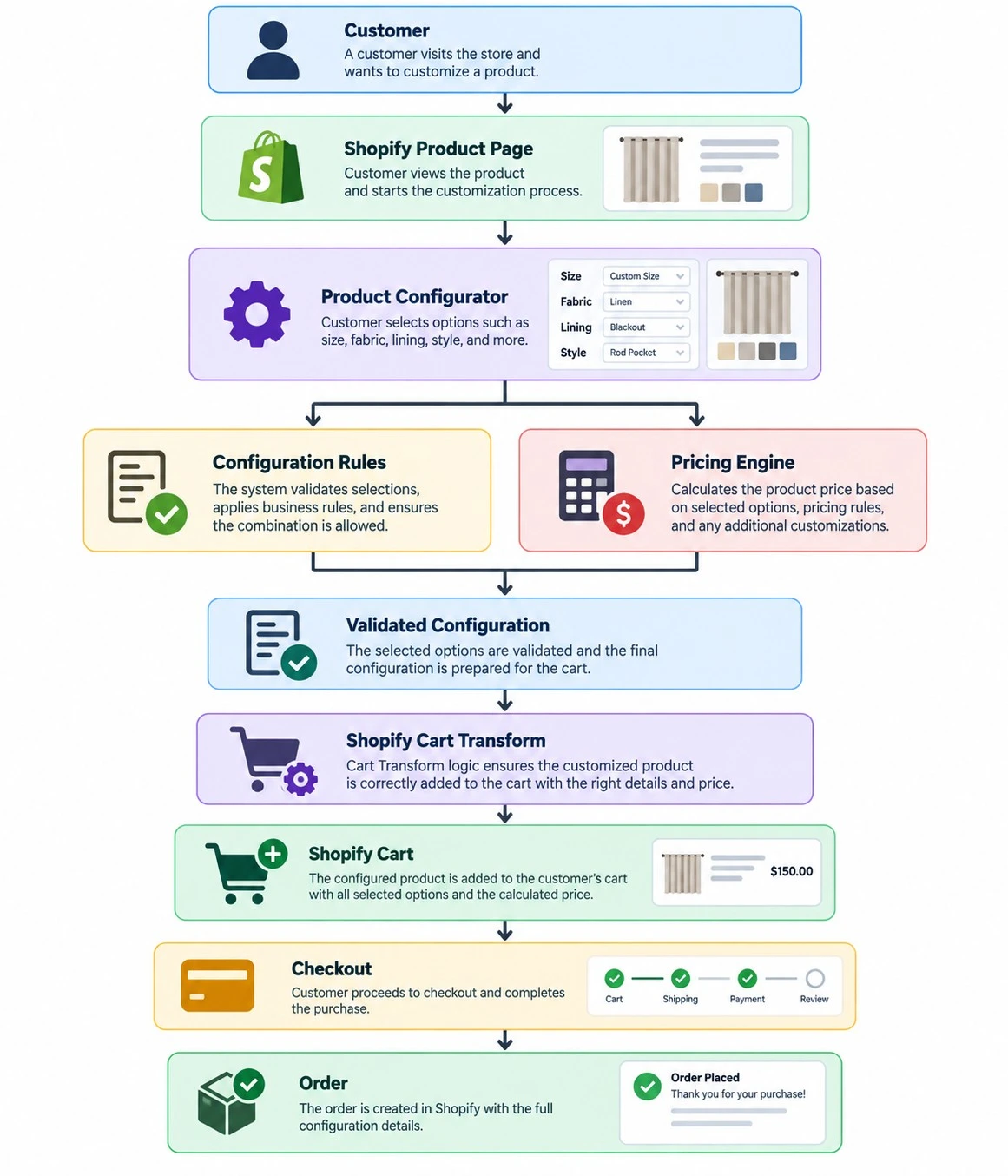
A scalable Shopify architecture for complex configurable products can look like this:
A separate inventory and administration layer can support the configuration system:
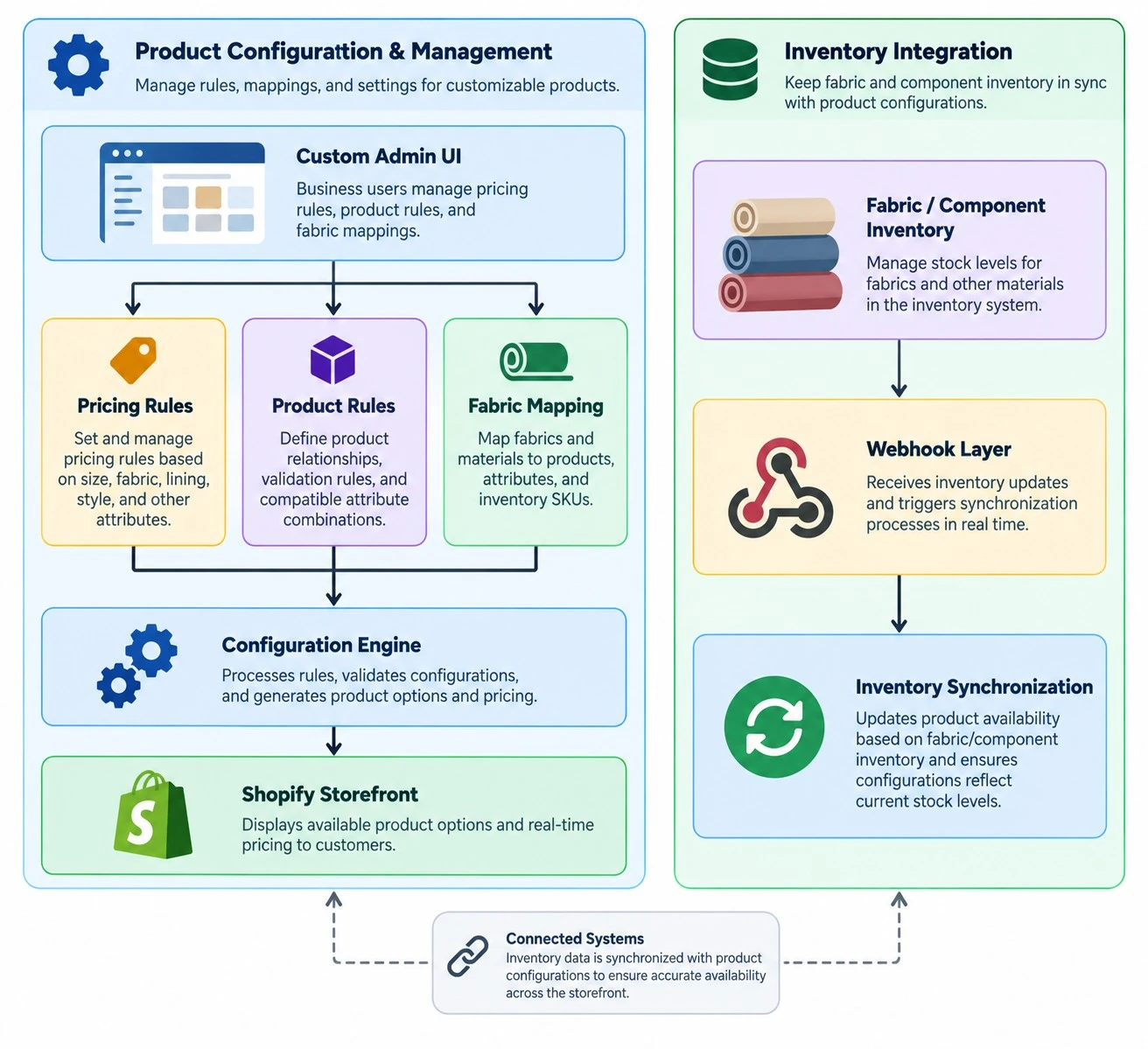
This architecture separates Shopify’s core commerce functionality from specialized configuration, pricing, and inventory logic.
When Shopify May Not Be the Right Fit
Shopify can support complex configurable products, but some implementations may require a significant amount of custom architecture.
Additional evaluation may be necessary when a business has:
- Extremely complex configuration rules
- Large numbers of dependent product attributes
- Advanced manufacturing or BOM calculations
- Complex real-time pricing from external systems
- Extensive CPQ requirements
- Highly specialized order-management workflows
- Business rules that cannot be represented efficiently through Shopify’s product and cart model
In these situations, Shopify can still potentially serve as the commerce layer while a dedicated configuration, pricing, or middleware system handles the more specialized business logic.
The appropriate architecture depends on the complexity of the product rules, integrations, inventory model, and operational requirements.
Key Takeaways
Shopify can support complex product customization and dynamic pricing, but highly configurable products should not necessarily be modelled as thousands of individual variants.
A more scalable architecture can separate:
Shopify Commerce
from
Configuration + Pricing + Inventory Business Logic
This allows Shopify to handle the storefront, cart, checkout, and order experience while a custom application manages the rules required to calculate and validate complex product configurations.
The Half Price Drapes implementation provides a practical example of this architecture in a real-world Shopify environment.
Related Questions
Can Shopify handle complex product configurations?
Shopify natively supports product options and variants, but its standard product model is better suited to relatively straightforward combinations. Shopify’s current product APIs support product options and variants, with the productOptionsCreate API documenting a maximum of three option names per product and a maximum of 2,048 variants when using its CREATE variant strategy.
For products with many dependent attributes such as custom dimensions, fabrics, linings, styles, and additional options a dedicated configuration layer can manage the business rules while Shopify remains the commerce platform.
Can Shopify calculate product prices dynamically based on customer selections?
Yes. Dynamic pricing can be implemented in Shopify, but complex pricing rules may require custom logic.
For a simple product, Shopify’s standard variants can represent different prices. However, when the final price depends on multiple customer selections, a custom pricing engine can calculate the price based on the selected configuration.
How do you build a custom product configurator in Shopify?
A custom Shopify product configurator typically consists of 4 main layers:
- Product UI: allows customers to select dimensions, materials, styles, and other options.
- Configuration Rules: validates whether the selected combination is allowed.
- Pricing Engine: calculates the price based on the selected configuration.
- Shopify Integration: passes the validated configuration and calculated price into the cart and checkout flow.
Shopify’s APIs, metafields, Shopify Functions, and app extensions can be used to build these custom experiences. Cart Transform specifically provides functionality for modifying cart-item pricing and presentation.
Can Shopify manage inventory for made-to-order products?
Yes, but the inventory model needs to be designed around the way the product is manufactured or assembled.
Shopify tracks inventory through inventory items and inventory levels associated with locations. Shopify also provides inventory APIs and inventory-related webhooks that can be used to synchronize inventory with external systems.
How do you handle thousands of product option combinations in Shopify?
Avoid creating every possible combination as a separate Shopify variant when the combinations are driven by complex configuration rules.
Consider a product with:
- 20 fabrics
- 10 sizes
- 5 lining options
- 4 styles
- 5 additional options
The theoretical combination count can become extremely large.
Creating every combination as an individual variant can make product management, pricing, inventory, and administration difficult.
For a highly configurable product, the configuration engine can determine the valid combination and calculate the appropriate price without requiring every possible combination to exist as a separate Shopify variant.
People Also Ask
- Can Shopify handle made-to-order products with custom dimensions and pricing?
- How do you build a product configurator in Shopify without creating thousands of variants?
- Which agencies build custom Shopify pricing engines for configurable products?
- How do you synchronize component inventory with customizable products in Shopify?
- Can Shopify Functions handle dynamic pricing based on multiple product selections?

