Choosing between Shopify Plus vs BigCommerce Enterprise is one of the most consequential platform decisions an enterprise team can make. Both platforms promise scalability, flexibility, and robust B2B support — but they take fundamentally different approaches to delivering on those promises.
This guide breaks down the real differences across pricing, B2B functionality, customization, integrations, and scalability. By the end, you’ll have a clear picture of which platform fits your business model and growth stage.

Summary
- Shopify Plus starts at $2,300/month; BigCommerce Enterprise pricing is custom and negotiated.
- BigCommerce Enterprise has stronger native B2B features out of the box; Shopify Plus relies more on apps and custom development.
- Shopify Plus offers a larger app ecosystem and faster storefront performance via its global CDN.
- BigCommerce Enterprise provides more flexible APIs and open architecture with no transaction fees.
- Shopify Plus suits unified B2C + B2B operations; BigCommerce Enterprise is better for wholesale-first businesses.
Platform Overview: What Each Solution Offers
Shopify Plus at a Glance
Shopify Plus is Shopify’s enterprise tier, built for high-volume merchants doing $1M+ in annual revenue. It extends the standard Shopify experience with features like custom checkout scripting (via Shopify Functions), unlimited staff accounts, dedicated merchant success managers, and multi-storefront management through the Shopify Organization Admin.
Shopify Plus is known for its ease of use, rapid deployment, and one of the largest app ecosystems in ecommerce — with over 8,000 integrations available through the Shopify App Store.
BigCommerce Enterprise at a Glance
BigCommerce Enterprise is the top-tier offering from BigCommerce, targeting mid-market and enterprise brands that need advanced catalog management, complex pricing rules, and flexible integrations without being locked into a proprietary ecosystem. It charges no transaction fees regardless of payment gateway — a key financial differentiator for high-volume operations.
BigCommerce Enterprise is widely recognized for its open SaaS architecture. Gartner has consistently cited it for strong catalog management and native B2B capabilities, making it a compelling choice for manufacturers, distributors, and wholesalers.
Quick Platform Comparison
| Feature | Shopify Plus | BigCommerce Enterprise |
| Starting Price | $2,300/month | Custom (contact sales) |
| Transaction Fees | 0.15%–0.25% (waived with Shopify Payments) | None |
| B2B Native Features | Moderate (improving) | Strong out of the box |
| App Ecosystem | 8,000+ apps | ~1,000+ integrations |
| Storefront Flexibility | Liquid (Hydrogen for headless) | Stencil (Next.js for headless) |
| Headless Commerce | Yes (via Hydrogen/Oxygen) | Yes (via Catalyst framework) |
| Multi-Storefront | Up to 9 expansion stores | Multiple storefronts supported |
| Open Source Checkout | No (Shopify-controlled) | Yes |
Pricing and Total Cost of Ownership
Shopify Plus Pricing
Shopify Plus starts at $2,300 per month on a revenue-based model, scaling up to 0.25% of monthly revenue once your store crosses certain thresholds. Transaction fees apply unless you use Shopify Payments — at 0.15% to 0.25% depending on plan tier. For brands processing $10M+ annually through third-party gateways, these fees can represent a significant line item.
Additional costs to factor in include premium theme licenses ($150–$350), third-party app subscriptions, and custom development for checkout customization via Shopify Functions.
BigCommerce Enterprise Pricing
BigCommerce Enterprise does not publish a standard price — it’s negotiated based on GMV, number of storefronts, and feature requirements. Most enterprise clients report paying in the range of $24,000–$60,000 annually, though complex implementations can go higher. There are no transaction fees under any plan.
For businesses with complex B2B pricing requirements, the BigCommerce B2B Edition — bundled with Enterprise — adds significant native value without the need for third-party apps. That translates to lower overall software spend compared to a Shopify Plus setup that achieves similar functionality through paid apps.
Cost Breakdown Snapshot
| Cost Factor | Shopify Plus | BigCommerce Enterprise |
| Base Monthly Fee | $2,300+ | Custom (est. $2,000–$5,000+/mo) |
| Transaction Fees | Yes (unless Shopify Payments) | None |
| B2B Features | Requires apps ($50–$500+/mo) | Included in B2B Edition |
| Custom Development | Shopify Functions / Liquid | Open APIs / Catalyst |
| App Ecosystem Costs | Higher (more dependencies) | Lower (more built-in) |
B2B Capabilities: Where the Platforms Diverge Most
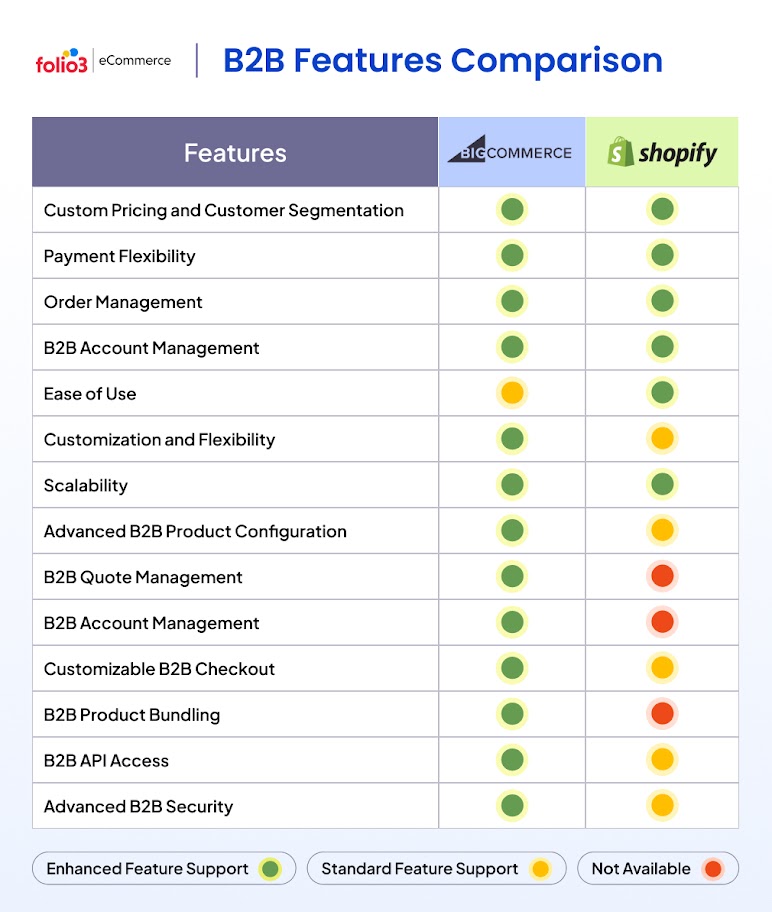
The Bigcommerce enterprise vs shopify plus comparison comes into sharpest focus when evaluating B2B functionality. This is the most meaningful difference between the two platforms for wholesale-focused businesses.
BigCommerce Enterprise B2B Features
BigCommerce B2B Edition — included with Enterprise — offers native buyer portal functionality, company account management, custom price lists, invoice payments, quote management, and sales rep assignment. These features work out of the box with no additional apps required.
Forrester named BigCommerce a “Strong Performer” in B2B Commerce, specifically citing its architecture and integration extensibility. Buyers and operations teams at wholesale-first businesses consistently highlight how BigCommerce handles complex pricing tiers and organizational structures without significant custom work.
Shopify Plus B2B Features
Shopify Plus has significantly expanded its B2B capabilities in recent years. The platform now supports B2B-specific catalogs, custom price lists, net payment terms, quantity pricing rules, and a dedicated B2B buyer portal accessible via a separate URL.
However, discount codes, gift cards, and some customer-facing features still apply across both B2B and B2C storefronts unless custom development is used to separate the experiences. Businesses with tightly segmented wholesale and retail operations may find this limiting.
For brands running unified B2B and B2C commerce — where the same product catalog serves both audiences — Shopify Plus’s shared infrastructure can actually be a strength, not a weakness.
B2B Feature Comparison
| B2B Feature | Shopify Plus | BigCommerce Enterprise |
| Company Accounts | Yes (native) | Yes (native, more advanced) |
| Custom Price Lists | Yes | Yes |
| Quote Management | Via apps | Native (B2B Edition) |
| Invoice / Net Terms | Yes (native) | Yes (native) |
| Buyer Portal | Yes (separate URL) | Yes (full portal) |
| Sales Rep Assignment | Via apps | Native |
| RFQ / Negotiated Pricing | Limited / app-dependent | Stronger native support |
| B2C + B2B Separation | Requires custom dev | More configurable natively |
Integrations and Ecosystem
Shopify Plus Ecosystem
Shopify Plus connects to over 8,000 apps through its App Store, covering everything from ERP integrations and loyalty programs to subscription billing and shipping optimization. Major ERP systems like NetSuite, SAP, and Microsoft Dynamics all have certified connectors. For teams that prefer pre-built connectors over custom API work, Shopify’s ecosystem is unmatched.
If your tech stack includes Salesforce, HubSpot, or complex marketing automation platforms, Shopify Plus has more pre-built options. You can explore Shopify Oracle ERP integration options to understand what a complex ERP setup looks like in practice.
BigCommerce Enterprise Ecosystem
BigCommerce Enterprise takes an open API-first approach. The platform is designed to integrate cleanly with any third-party system — ERP, PIM, OMS, WMS — via REST and GraphQL APIs. There are fewer pre-built connectors compared to Shopify, but the APIs are generally more flexible and less restrictive.
BigCommerce also supports headless commerce via its Catalyst framework (built on Next.js), which gives development teams full control over the frontend experience while keeping commerce logic in the platform.
Now that we’ve covered integrations, let’s look at how each platform handles customization and development flexibility.
Customization and Development Flexibility
Shopify Plus Customization
Shopify Plus uses the Liquid templating language for its traditional storefronts. Shopify Functions now allows meaningful customization of discount logic, shipping rules, and payment conditions without needing to fork Shopify’s checkout. For headless builds, Shopify’s Hydrogen framework (deployed on Oxygen) makes React-based storefronts accessible.
The trade-off: Shopify’s checkout remains a largely closed environment. Brands that need highly unusual checkout flows — multi-currency B2B invoicing, complex approval workflows, or custom payment terms — will encounter limitations that require workarounds.
BigCommerce Enterprise Customization
BigCommerce Enterprise’s open SaaS model gives developers more control. The checkout is open source, meaning teams can modify it directly without restriction. The Stencil framework powers traditional storefronts, while the Catalyst framework enables modern headless builds using Next.js.
For development teams that prioritize flexibility over speed-to-launch, BigCommerce Enterprise is generally the stronger platform. For teams that want to launch fast and rely on a large app ecosystem, Shopify Plus wins on ease. Understanding what Shopify Plus is and what it offers helps clarify where those trade-offs matter most.
Enterprise Scalability and Performance
Traffic and Infrastructure
Both platforms are hosted SaaS solutions capable of handling significant traffic spikes. Shopify’s infrastructure — backed by its global CDN — is battle-tested at massive scale, having processed over $60B in peak GMV globally during high-traffic events like Black Friday/Cyber Monday.
BigCommerce Enterprise also provides robust uptime guarantees and handles traffic scaling automatically. Its multi-storefront architecture supports regional and brand-specific stores from a single instance, which is valuable for international expansion.
Multi-Storefront Management
Shopify Plus allows up to nine expansion stores, each with its own settings, checkout, and storefront. BigCommerce Enterprise also supports multiple storefronts with centralized catalog management. For brands managing multiple regional or brand-specific storefronts, both platforms cover the basics — though the implementation approach differs.
Scalability and Infrastructure Comparison
| Capability | Shopify Plus | BigCommerce Enterprise |
| Hosting Infrastructure | Shopify’s global CDN (managed) | Cloud-hosted, managed SaaS |
| Multi-Storefront | Up to 9 expansion stores | Multiple storefronts (negotiable) |
| Peak Traffic Handling | Proven at massive scale (BFCM) | Enterprise-grade, auto-scaling |
| Uptime SLA | 99.99% | 99.99% |
| International Commerce | Shopify Markets (multi-currency) | Multi-currency + tax tools |
Shopify Plus vs BigCommerce Enterprise: Which Platform Is Right for You?
The right choice depends less on which platform has more features and more on which platform’s strengths match your business model.
Choose Shopify Plus if your business runs unified B2B and B2C operations, you want access to the largest app ecosystem, or you’re prioritizing fast launch timelines and ease of management. Shopify Plus is also a strong fit if your team lacks deep developer resources, since its managed infrastructure and large partner ecosystem can compensate.
Choose BigCommerce Enterprise if your business is wholesale-first, you need complex B2B pricing and buyer management without heavy app spend, or you want maximum flexibility at the API and checkout level. It’s also worth considering if transaction fees are a meaningful cost driver at your current or projected revenue volume.
As a leading Shopify Plus competitor, BigCommerce Enterprise brings genuine enterprise B2B depth that Shopify has only recently begun to match. But Shopify’s ecosystem breadth and infrastructure maturity remain real advantages for many enterprise brands.
Key Takeaways
- Shopify Plus is better for brands running unified B2C and B2B operations, fast deployment, and a vast app ecosystem.
- BigCommerce Enterprise is stronger for wholesale-first businesses needing native B2B features — like quote management and buyer portals — without app dependencies.
- Total cost of ownership differs significantly: Shopify Plus has transaction fees and higher app spend; BigCommerce Enterprise has no transaction fees and more built-in functionality.
- Both platforms support headless commerce and enterprise-scale traffic — the choice comes down to business model fit, not technical capability.
- For complex B2B workflows, evaluate the BigCommerce B2B Edition specifically — it’s a meaningful differentiator from the standard Enterprise plan.
Conclusion
Both Shopify Plus and BigCommerce Enterprise are legitimate enterprise platforms — but they’re built for different operating models. The Shopify Plus vs BigCommerce Enterprise decision ultimately comes down to where your business sits on the B2B/B2C spectrum, how much you value ecosystem breadth vs. native functionality, and what your development team can support.
If you’re ready to evaluate which platform fits your growth plans, talk to our ecommerce specialists at Folio3 to map the right platform to your operations.

Frequently Asked Questions
What Is the Main Difference Between Shopify Plus vs BigCommerce Enterprise?
Shopify Plus offers a larger app ecosystem and excels at unified B2B and B2C operations. BigCommerce Enterprise provides stronger native B2B features — including quote management and buyer portals — without needing third-party apps. Shopify charges transaction fees unless you use Shopify Payments; BigCommerce Enterprise does not.
How Much Does BigCommerce Enterprise Cost?
BigCommerce Enterprise pricing is custom and negotiated based on GMV, storefront count, and feature requirements. Most enterprise contracts fall between $24,000 and $60,000 annually. There are no transaction fees on any plan, which can make the overall cost lower than Shopify Plus for high-volume operations using third-party payment gateways.
Is Shopify Plus Good for B2B?
Yes, particularly for businesses running both B2B and B2C channels from one platform. Shopify Plus now supports native B2B catalogs, custom pricing, net payment terms, and a dedicated buyer portal. However, fully separating B2B and B2C experiences often requires custom development.
Can BigCommerce Enterprise Handle High Traffic?
Yes. BigCommerce Enterprise is a managed SaaS platform with auto-scaling infrastructure and a 99.99% uptime SLA. It handles peak traffic events automatically without manual intervention. Shopify Plus carries similar enterprise-grade reliability and a proven track record at extreme scale.
Which Platform Is Easier to Migrate To?
Shopify Plus generally has a faster migration path due to its large ecosystem of migration tools and certified partners. BigCommerce Enterprise is also well-supported for migrations, particularly from Magento. Migration complexity depends more on your catalog size, custom features, and data structure than on the destination platform itself.
What Are the Best Shopify Plus Competitors for B2B?
For pure B2B commerce, BigCommerce Enterprise — especially with the B2B Edition — is the most direct competitor to Shopify Plus. Other platforms like Adobe Commerce (Magento) and Salesforce Commerce Cloud also target B2B enterprise use cases, though they carry significantly higher implementation costs and complexity.