With global ecommerce sales projected to reach $6.42 trillion in 2025, your platform choice directly impacts whether you’ll capture market share or fall behind.
But this isn’t about features—it’s about choosing between two operational philosophies: managed simplicity versus complete control.
We compare WooCommerce vs Shopify to help you decide which platform works best for your eCommerce business.
Summary
- True costs beyond monthly fees and “free” plugins
- Compliance responsibilities that create financial and legal risk
- Performance benchmarks showing how platform choice affects conversion rates
- Scalability differences from startup to enterprise
- Decision frameworks for matching a platform to your business model
Understanding the Platform Philosophy of WooCommerce vs Shopify
The Shopify Approach: Managed Commerce Infrastructure
Shopify is a fully hosted, Level 1 PCI-DSS compliant platform handling hosting, security, and infrastructure by default.
With $8.8 billion in revenue in 2024 (22.3% growth), that investment flows into platform development and automatic compliance updates that every merchant inherits.
The WooCommerce Model: Open-Source Flexibility
WooCommerce, powering 4.65 million websites with a 20.1% global market share, provides complete control over your technology stack. Learn how this flexibility works in real-world cases in our blog on WooCommerce for Enterprises.
But control means responsibility; PCI DSS compliance falls on the store owner, requiring secure hosting, security best practices, and PCI-compliant payment gateway integration.
What’s Driving The WooCommerce vs Shopify Decision in 2025?
Market Maturation: B2B ecommerce at $32.11 trillion in 2025, reaching $36.16 trillion by 2026, demands platforms that enable growth without inflating costs.
Compliance Complexity: Data breaches average $4.45 million in costs, making platform security a board-level concern.
Conversion Optimization: Average Shopify stores convert at 1.4%, with top 20% achieving 3.2% and top 10% reaching 4.7%. Platform performance directly impacts revenue.
| Decision Factor | WooCommerce Approach | Shopify Approach | Best For |
| Control Philosophy | Complete ownership and customization | Managed infrastructure with guardrails | WooCommerce: Complex, unique requirements; Shopify: Fast deployment, managed risk |
| Initial Investment | Lower (free plugin) | Higher ($29-$2,500+/month) | WooCommerce: Budget-conscious startups; Shopify: Resource-constrained teams |
| Technical Responsibility | Self-managed hosting, security, and compliance | Fully managed by Shopify | WooCommerce: Tech-savvy teams; Shopify: Business-focused operations |
| Scalability Model | Dependent on the hosting infrastructure | Built-in, automatic scaling | WooCommerce: Predictable growth; Shopify: Rapid expansion |
How Much Will WooCommerce vs Shopify Cost You?
Breaking Down WooCommerce vs Shopify Pricing
Shopify pricing starts at:
- $29/month (basic)
- $79 (mid-tier)
- $299 (advanced)
- Shopify Plus at $2,500+/month.
But add transaction fees (2% without Shopify Payments), apps ($10-300/month), and premium themes ($100-500), and costs multiply.
WooCommerce appears free but requires:
- Hosting ($30-500+/month)
- SSL certificates
- PCI-compliant infrastructure with regular ASV security scans
- Premium plugins ($100-1,000+)
- Developer time for maintenance.
Explore more in our blog on WooCommerce Pricing Plans.
Real-World Example: $12M Annual Revenue Business
Shopify Plus:
- Subscription: $30,000/year
- Apps/extensions: $5,000/year
- Total: ~$35,000-40,000/year
WooCommerce:
- Enterprise hosting: $3,600-6,000/year
- Developer maintenance: $50,000-80,000/year
- Security/compliance: $5,000-10,000/year
- Premium extensions: $3,000-5,000/year
- Total: ~$61,600-101,000/year
The paradox? “Free” WooCommerce often costs complex enterprises more than managed platform subscriptions.

When WooCommerce Costs Less
- Small to Medium Businesses ($500K-$3M revenue): Quality managed hosting ($50-150/month) plus standard plugins delivers lower TCO than Shopify’s middle tiers.
- Content-First Businesses: WordPress powers 43.4% of all websites—if your model depends on blogging, SEO, and rich content, WooCommerce’s foundation provides inherent advantages. We deliver full support through our WordPress eCommerce development services including content + commerce synergy.
- In-House Development Teams: When you already employ PHP/WordPress developers, customization becomes an asset versus a burden.
The Compliance Reality of WooCommerce vs Shopify: Who’s Really Responsible?
Shopify’s Compliance Advantage
Shopify stores are fully PCI compliant by default, with automatic updates to requirements.
Shopify absorbs the compliance burden—your team doesn’t need to manage the 12 core PCI DSS requirements, including firewall configuration, encryption standards, and security testing.
WooCommerce’s Compliance Requirements
WooCommerce’s core plugin isn’t PCI certified. Once your site accepts card payments—even via hosted gateways like WooPayments—it falls within PCI DSS scope. To protect your store, follow our guide on WooCommerce Security Tips.
Your Responsibilities:
- PCI-compliant hosting with secure infrastructure
- SSL implementation across checkout
- Regular ASV security scans
- Security policies and procedures
- Plugin/theme vulnerability management
The Risk: Non-compliance can result in $5,000-$100,000/month fines, lawsuits, and loss of card processing ability. Even with hosted payment solutions, the WooCommerce store must uphold security standards for hosting, plugins, and user access.
Performance, Conversion, and Scalability
When comparing WooCommerce vs Shopify, store performance and scalability must be taken into account to accommodate for higher conversions.
Conversion Rate Reality
Global ecommerce conversion rates average 2-4%, varying significantly by industry (food/beverage at 4.9%, home/furniture at 1.4%).
Platform architecture affects these numbers through page speed, checkout friction, and mobile optimization.
Every one-second page load delay causes a 7% conversion decrease.
Shopify’s managed infrastructure and CDN provide consistent performance, while WooCommerce’s speed depends on hosting choice and optimization. See our tips to speed Up WooCommerce Checkout for better conversions.
Mobile Commerce Impact
Mobile dominates traffic at 73% but desktop converts higher. Shopify themes come mobile-optimized by default; WooCommerce requires careful theme selection and testing.
Check our blog on WooCommerce product page customization to see how you can improve mobile shopping experiences.
Scalability Approaches
Shopify: Infrastructure automatically adjusts to traffic spikes. Limitation: API rate limits (2 requests/second standard, four on Advanced, 20 on Plus, 40 on enterprise).
WooCommerce: Scalability depends on hosting—more power means more cost. For enterprise scaling, our WooCommerce PIM Integration guide shows how to handle large catalogs effectively.
You control scaling, timing, and method, but need specialized development expertise for enterprise-grade optimization.
WooCommerce vs Shopify: When to Choose Each Platform
Here’s how we separate WooCommerce vs Shopify:
Choose Shopify When:
- Speed to Market Is Critical: Launch in weeks, not months, without infrastructure delays.
- Technical Resources Are Limited: Your team focuses on operations, not server management and security audits.
- International Expansion Is Planned: Shopify Markets provides multi-currency, customs, and localization tools from one dashboard.
- Compliance Concerns You: Default Level 1 PCI compliance eliminates complex security management requirements.
- Predictable Costs Matter: Fixed monthly costs versus variable technical infrastructure expenses.
Choose WooCommerce When:
- Customization Is Non-Negotiable: Your business model requires unique functionality beyond platform constraints.
- Technical Capabilities Exist: Your team includes PHP/WordPress developers comfortable with infrastructure management.
- Content Drives Strategy: WordPress’s content management supports businesses where blogging, SEO, and rich content drive commerce.
- Maximum Control Is Required: You want to own data, choose hosting, and make infrastructure decisions.
- Budget Flexibility Exists: You can absorb variable costs for hosting, development, and maintenance as you scale.
SEO and Dropshipping Considerations
Here’s how to compare WooCommerce vs Shopify for dropshipping and SEO:
WooCommerce vs Shopify for SEO
Shopify includes essential SEO features (title tags, meta descriptions, XML sitemaps) but has URL customization limitations and tricky sub-category creation.
WooCommerce provides complete URL structure control and easier sub-categories. Integration with Yoast SEO and Rank Math offers advanced optimization for technical SEO teams. For more, explore our essential WooCommerce features.
Reality: Both platforms provide essential SEO functions for successful stores—the choice depends on technical comfort, not capability gaps.
For Dropshipping
Shopify: Extensive app ecosystem (Oberlo, Spocket, Modalyst) automates product imports, inventory sync, and fulfillment. Managed infrastructure lets you focus on marketing.
WooCommerce: Plugins like AliDropship provide similar functionality with more customization. For more advanced use cases—erp, CRM, marketplaces see our review of WooCommerce integration services.
For deeper insights, read our guide on Dropshipping with WooCommerce. Trade-off: you manage hosting and security while competitors on managed platforms focus purely on acquisition.

Key Questions To Ask When Comparing WooCommerce vs Shopify
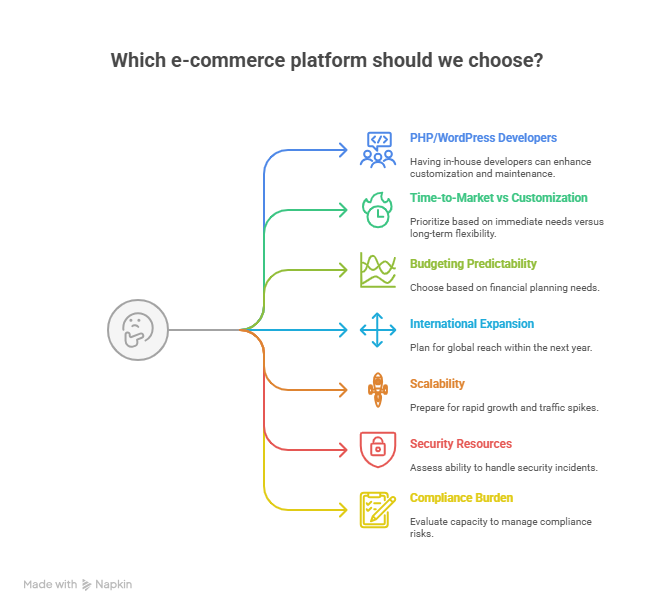
Before deciding on WooCommerce vs Shopify, audit the business with these questions in mind:
Technical Capacity:
- Do we have PHP/WordPress developers in-house?
- Can we manage hosting, security updates, and plugin compatibility?
Business Priorities:
- Is time-to-market or customization more important?
- How critical is predictable monthly budgeting versus variable costs?
Growth Plans:
- Are we planning international expansion within 12 months?
- Will we scale rapidly with unpredictable traffic spikes?
Risk Tolerance:
- Can we absorb the compliance burden and associated risk?
- Do we have the resources to handle security incidents ourselves?
Conclusion
When picking between WooCommerce vs Shopify, you’re choosing between operational philosophies, not just features.
Choose Shopify for guaranteed operational excellence, automatic compliance, and infrastructure that scales without intervention. You trade customization flexibility for reduced technical burden and predictable costs.
Choose WooCommerce when complete control justifies increased complexity. You’ll invest in technical expertise and manage infrastructure responsibilities in exchange for unlimited customization and potentially lower costs at smaller scales.
FAQs
Is WooCommerce really free compared to Shopify?
WooCommerce’s core plugin is free, but you’ll pay for hosting, security, themes, and plugins. Total costs range from $30-$100/month for small businesses, but can exceed Shopify pricing for complex sites requiring significant development work.
Which is better for dropshipping—WooCommerce or Shopify?
Shopify dominates dropshipping with its app ecosystem and managed infrastructure, letting you focus on marketing. WooCommerce works but requires more technical management for hosting and integration layers.
Can I switch from WooCommerce to Shopify later?
Yes, but data migration can be complex. Our tutorial on Migrating Products from WooCommerce to Shopify explains the process in detail. Plan for 4-8 weeks for proper migration, including products, customers, and SEO redirects. Many apps exist to automate parts of this process.
Which platform is better for SEO?
WooCommerce offers more granular control through WordPress’s content capabilities and SEO plugins. Shopify covers essential SEO needs adequately. For most businesses, the difference won’t significantly impact results.
Do I need technical skills to use WooCommerce?
Basic setup is manageable for non-technical users, but maintaining security, handling plugin conflicts, and troubleshooting requires technical knowledge or hiring developers. You can Hire WooCommerce Developers from our team to manage ongoing support.