High growth brands increasingly need specialized Shopify Plus development for enterprise to unify complex catalogs, B2B workflows, and multisystem integrations at scale. Enterprise‑grade builds demand architects who can deliver headless commerce, ERP/PIM/AI integrations, and zero‑downtime migrations; backed by ongoing optimization.
Shopify Plus development for enterprise means purpose‑built, integrated storefronts that scale globally, handle wholesale complexity, and deliver measurable ROI with predictable total cost of ownership.
Overview
Enterprise Shopify projects differ from standard stores because they must orchestrate multiple systems, teams, and channels with minimal risk. They require performance engineering, compliance, data governance, and automation across merchandising, operations, and finance.
Specialized agencies design composable architectures, integrate ERPs and OMSs, build B2B portals, and harden and optimize store performance for peak traffic.
Services include:
- Shopify Migration
- Custom app development
- Headless builds
- Cross‑border storefronts
- Wholesale pricing and approvals
- Continuous CRO.
For quick reference: Shopify Plus development for enterprise is a specialized discipline delivering tailored, integrated, and scalable commerce for large organizations with complex workflows and growth targets.
1. Folio3 eCommerce
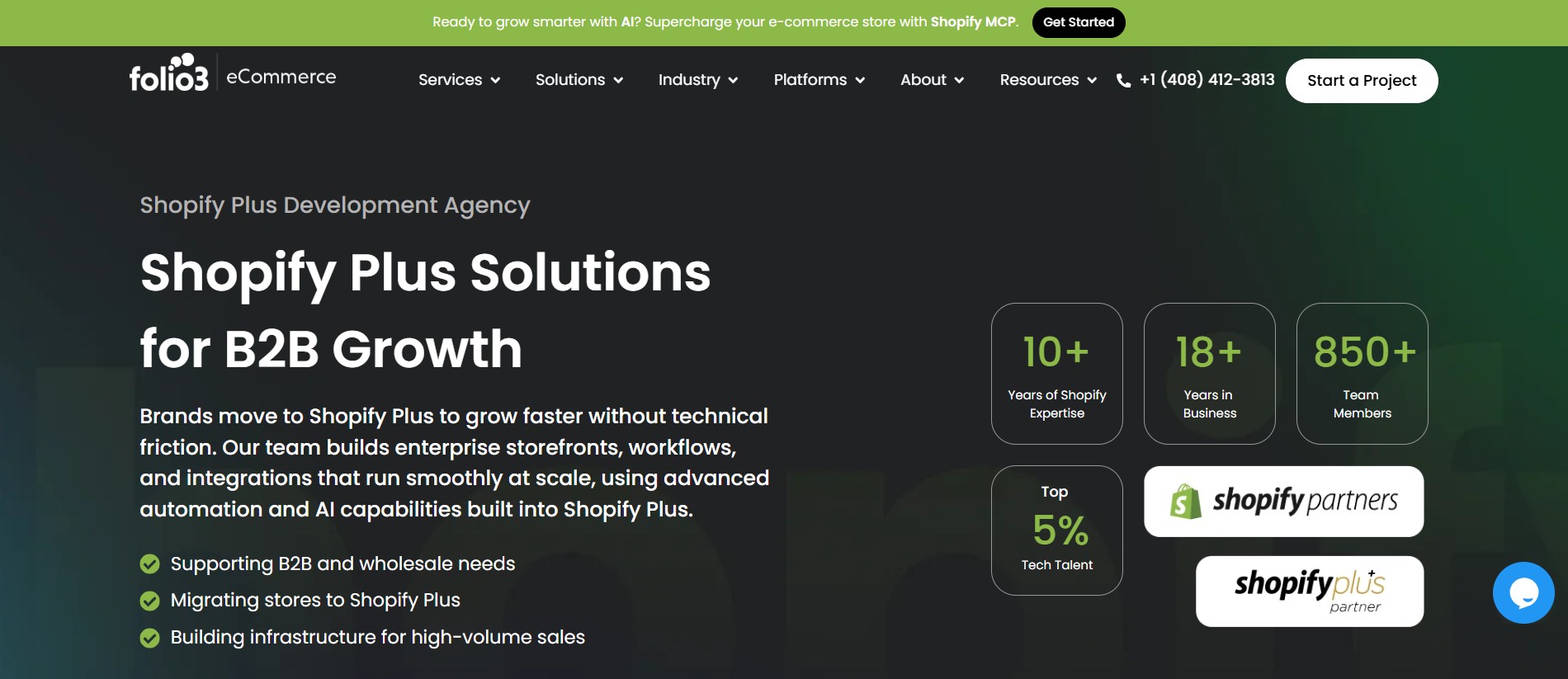
Folio3 Ecommerce empowers manufacturers, wholesalers, distributors, and retailers with custom, secure, and scalable eCommerce solutions.
They specialize in B2B and enterprise Shopify Plus, delivering custom architectures, resilient integrations (ERP, PIM, CRM, OMS, AI), and performance engineering.
Differentiators include headless builds, native mobile apps, AI‑powered experiences (e.g., visual search and virtual try‑on), and robust workflows like bulk ordering, account‑based pricing, approvals, and negotiated terms.
With a business‑first mindset, Folio3’s benefit‑first delivery drives Amazon‑grade reliability, agile roadmaps, and transparent TCO so leaders can forecast cost and ROI.
Definition: Shopify Plus development for enterprise refers to the creation of tailored, scalable, and highly integrated Shopify Plus solutions that meet the specialized needs of large organizations requiring robust workflows, advanced features, and seamless scalability.
Explore services via Shopify Plus agency, Shopify headless development, and Shopify custom apps development pages, and review enterprise outcomes in the Screw Fix case study.
Key Takeaway: Folio3 Ecommerce delivers end‑to‑end, enterprise‑grade Shopify Plus solutions with headless, AI, and deep B2B integration capabilities, backed by transparent pricing and measurable ROI.
2. FYRESITE
FYRESITE is a long‑standing Shopify Plus partner with 12+ years of enterprise delivery, including zero‑downtime migrations and no data‑loss guarantees. Typical enterprise builds range from $25,000–$150,000, signaling robust integration and UX scopes.
Notable clients include Fairlife and Banner Health, reflecting regulated and high‑volume requirements.
Services span end‑to‑end builds, custom app and ERP integrations, and UX optimization across checkout and retention. For rapid scoping, FYRESITE offers transparent estimates, pilot phases, and risk‑managed launches aligned to enterprise governance. For further details, see this overview of leading Shopify Plus agencies and enterprise ranges.
| Location | Typical Project Range | Unique Features | |
| USA | $25,000–$150,000 | Zero‑downtime migration, no data‑loss guarantee, UX‑led builds |
Source: summary of ranges and capabilities in this enterprise‑focused roundup.
Key Takeaway: FYRESITE specializes in risk‑managed, zero‑downtime migrations with a strong focus on UX and enterprise‑level integrations.
3. We Make Websites
We Make Websites is known for luxury branding, international scaling, and analytics‑led decision making. With London and NYC offices, they handle global rollouts and complex catalogs across regions.
Average project size typically ranges from $40,000–$250,000 for enterprise cycles, aligning investment with brand, UX research, and multi‑storefront complexity.
Case studies include visually demanding, content‑rich builds for brands like Hasbro and Pangaia.
Best fit: design‑led enterprises seeking international storefronts with strong analytics instrumentation, retention UX, and performance across markets and devices.
Key Takeaway: We Make Websites excels at high‑end, design‑focused global Shopify Plus deployments backed by deep analytics.
4. Elkfox
Melbourne‑based Elkfox focuses on intricate integrations and custom functionality for Shopify Plus enterprises. Typical projects range from $20,000–$80,000, with a track record supporting brands like Koala and Frank Body.
Elkfox excels at bespoke apps and backend integrations that power B2B capabilities such as price lists, customer hierarchies, order approvals, and EDI. Industries include furniture, beauty, health, and consumer goods; often requiring subscription, bundling, and fulfillment logic.
Their strength is building reliable integration layers for scalable, enterprise‑grade operations and change‑friendly roadmaps.
Key Takeaway: Elkfox delivers robust B2B‑centric integrations and custom apps that enable complex pricing and fulfillment workflows.
5. Blend Commerce
UK‑based Blend Commerce specializes in retention and conversion‑led growth for enterprise Shopify Plus. Typical projects range from $15,000–$90,000 and emphasize long‑term optimization over one‑off builds.
Core services include CRO programs, A/B testing, data‑informed UX enhancements, and iterative growth sprints. Blend’s post‑launch model maintains momentum with measurable experiments, subscription upsell strategies, and checkout optimization.
Best fit: enterprises aiming to maximize lifetime value and repeat purchase through continuous, evidence‑based improvements.
Key Takeaway: Blend Commerce focuses on continuous CRO and data‑driven UX enhancements to drive long‑term revenue growth.
6. Uncap
Uncap is known for B2B and wholesale migrations to Shopify Plus, emphasizing speed and pricing transparency. The team ports legacy wholesale features; dealer portals, tiered and contract pricing, PO workflows, and net terms into scalable plus architectures.
This B2B readiness is essential for enterprises moving from complex platforms and preserving account‑level logic.
- B2B migration checklist:
-
- Tiered/contract pricing with rules and approvals
- Company accounts, roles, and permission hierarchies
- Net terms, PO, and quote‑to‑order workflows
- Punchout or EDI support for key accounts
- ERP/OMS sync for inventory, tax, and invoices
Key Takeaway: Uncap streamlines wholesale and B2B migrations with transparent pricing and comprehensive feature parity.
7. Skyloom Studios
Skyloom Studios emphasizes speed‑to‑value and measurable outcomes for enterprise Shopify Plus builds. Reported statistics include delivering a Plus store in six weeks, tripling sales for a client, and improving conversion rates by 40–60%.
Pricing is transparent (from $1,000+) and ratings are high (Google 5/5, Clutch 4.9/5, 98% completion rate). This profile fits brands needing rapid launches and clear results tracking with focused sprints.
- Delivery and outcomes:
| Metric | Reported Result | |
| Time‑to‑launch | 6 weeks for a Shopify Plus store | |
| Sales impact | Sales tripled for a specific client | |
| Conversion uplift | 40–60% improvement reported | |
| Ratings | Google 5/5; Clutch 4.9/5 | |
| Completion rate | 98% projects completed |
Evidence: enterprise outcomes summarized by Skyloom Studios’ 2025 guide [2].
Key Takeaway: Skyloom Studios delivers ultra‑fast, results‑focused Shopify Plus projects with proven ROI metrics.
8. WebBee Global
California‑based WebBee Global focuses on advanced Shopify Plus integrations for enterprise back offices. Teams build complex API connections to ERPs, CRMs, WMSs, and 3PLs, enabling reliable, automated data exchange at scale.
Definition: API integration connects different software systems, enabling automated data exchange and process synchronization without manual intervention. Typical integrations include NetSuite, SAP, Microsoft Dynamics, Salesforce, ShipStation, and EDI gateways.
Target industries include CPG, healthcare, and wholesale distribution—where accuracy, compliance, and fulfillment automation drive ROI and reduce manual reconciliation.
Key Takeaway: WebBee Global specializes in deep, enterprise‑level API integrations that automate critical back‑office processes.
9. Blue Acorn iCi
Blue Acorn iCi serves enterprise and Fortune‑level retailers with scalable system design and disciplined project management. Their end‑to‑end capabilities support multi‑brand portfolios, high SKU counts, and omnichannel experiences.
Compared to standard Shopify builds, enterprise projects add scalable content architectures, multi‑store governance, robust testing, data pipelines, and dedicated SRE practices.
This fit benefits large organizations needing predictable delivery, risk management, and long‑term optimization across markets and channels.
Key Takeaway: Blue Acorn iCi provides enterprise‑scale architecture, governance, and SRE practices for complex, multi‑brand retailers.
10. Swanky
As one of the first European Shopify Plus Experts, Swanky is a leader in conversion‑led international rollouts. Their methodology is performance‑driven, pairing CRO experimentation with data‑backed UX improvements.
Swanky’s history includes ongoing optimization retainers, market‑by‑market rollouts, and expanding cross‑border commerce with localized content, payments, and logistics.
Expect structured testing, cohort analysis, and roadmap governance; ideal for global growth and sustained performance across multiple regions and currencies [4].
Key Takeaway: Swanky combines CRO expertise with international rollout experience to accelerate global commerce performance.
11. Eastside Co
Eastside Co brings a technical and performance‑first approach to Shopify Plus. The team blends custom app development with SEO and long‑term CRO to grow enterprise KPIs.
Typical benefits include sustained organic traffic growth through technical SEO, content architecture, and site speed improvements, coupled with iterative CRO programs that compound over time.
Post‑launch, Eastside Co runs testing cycles, implements performance fixes, and builds features aligned to commercial goals; ensuring value scales month over month for enterprise teams [5].
Key Takeaway: Eastside Co focuses on technical SEO, performance, and iterative CRO to deliver continuous growth for enterprise merchants.
How to Choose the Right Shopify Plus Development Agency
Start by aligning your top risks to agency strengths: B2B complexity, integrations, design excellence, or CRO. Ask for evidence of similar enterprise projects, clarity of scope, post‑launch support models, and transparent pricing.
Confirm certifications (Shopify Plus Partner) and ensure technical depth in APIs, security, and performance. Map project type to fit below:
| Project Type | Best‑Fit Strength | Why It Matters | |
| B2B/Wholesale migration | B2B workflows, ERP integration | Protects account rules and operations | |
| Global rollout | Design + multi‑store ops | Ensures localized, compliant scaling | |
| Headless replatform | Composable + APIs | Long‑term flexibility and speed | |
| CRO‑led growth | Experimentation + analytics | Drives LTV and CAC efficiency | |
| Heavy integration | ERP/OMS/3PL expertise | Reduces manual work and errors |
Key Technical Capabilities for Enterprise Shopify Plus Projects
Enterprise leaders should verify headless readiness, robust APIs, automation, and custom app capacity.
Specialized offerings include B2B portals, region‑specific multi‑storefronts, bulk transactions, and complex fulfillment logic. Here are key capabilities to request, with concise definitions:
| Capability | Definition | |
| Headless commerce | A composable architecture separating frontend and backend for flexible, scalable stores [2] | |
| API integrations | Secure data sync with ERP/CRM/OMS/WMS for real‑time operations | |
| Custom apps | Tailored features that extend Shopify for unique workflows | |
| Automation | Flows/workflows to eliminate manual steps at scale | |
| B2B portals | Company accounts, roles, approvals, and contract pricing | |
| Multi‑storefront | Region/language catalogs with local tax, currency, and payments | |
| Performance engineering | Speed, caching, CDNs, and scalability for peak load | |
| QA and observability | Automated testing and monitoring for reliability |
Pricing Models and Budgeting for Shopify Plus Development
Enterprises typically choose fixed‑price scopes for clear deliverables or hourly/retainer models for iterative roadmaps.
Hourly rates range from $50–$200+ depending on complexity, seniority, and integration depth. Budget drivers include integrations (ERP/OMS/3PL), custom apps, B2B workflows, content and SEO, and ongoing CRO. Benchmarks below help calibrate expectations:
| Agency | Starting Price | Typical Range | Hourly Rate (if stated) | Scope Notes | |
| FYRESITE | From ~$25k | $25k–$150k | Varies | End‑to‑end, migration, UX | |
| We Make Websites | From ~$40k | $40k–$250k | Varies | Design‑led, global stores | |
| Elkfox | From ~$20k | $20k–$80k | Varies | Integrations, custom apps | |
| Blend Commerce | From ~$15k | $15k–$90k | Varies | CRO retainers, UX | |
| Skyloom Studios | From ~$1k | Varies | Varies | Rapid launch, measurable ROI | |
| Others (Uncap, WebBee, Blue Acorn iCi, Swanky, Eastside Co) | Contact | Enterprise engagements | Varies | B2B, integrations, scale |
Reference for hourly context: market ranges summarized by DigitalSuits’ analysis.
Migration and Post‑Launch Support for Enterprise Success
Successful enterprise migrations prioritize zero downtime, no data loss, and preserving historical orders, customers, and gift cards.
Best practices include sandbox rehearsals, phased cutovers, and data validation gates, followed by hypercare.
Post‑launch optimization means continuous monitoring, CRO experiments, feature releases, and proactive maintenance for security and performance.
- Enterprise migration flow:
-
- Audit data, systems, SEO, and risks
- Build integration and data pipelines
- Rehearse cutover in staging
- Phased rollout with rollback plan
- Hypercare: fix, optimize, measure
FYRESITE’s playbooks emphasize zero downtime and no data‑loss migration approaches for enterprise reliability.
Conclusion
If you need Shopify Plus development for enterprise outcomes, scalable architecture, ironclad integrations, and measurable growth, choose a partner aligned to your risks and roadmap.
Validate B2B workflows, headless and API depth, and CRO maturity. Demand transparent pricing, rigorous migration plans, and ongoing optimization, so your brand scales globally with predictable cost and durable ROI.
Frequently Asked Questions
What services do top Shopify Plus agencies provide?
Leading Shopify Plus agencies deliver end‑to‑end migration, custom themes, headless builds, integrations, CRO, and long‑term support. They also manage SEO, analytics, QA, and performance for enterprise scale.
How do I choose the right Shopify Plus agency for enterprise needs?
Prioritize agencies with similar enterprise projects, certifications, transparent pricing, and strong technical depth. Verify references from comparable brands and demand clear scopes and post‑launch plans.
What costs should I expect for Shopify Plus development projects?
Shopify Plus development for enterprise generally ranges from $20,000 to $250,000+. Complexity, integrations, custom features, and CRO retainers are the main cost drivers for total project budgets.
How do agencies ensure smooth migration to Shopify Plus?
Agencies plan staged migrations with sandbox testing, phased cutover, and data validation. Goals include no downtime, no data loss, and stable post‑launch performance with dedicated hypercare.
What ongoing support should enterprises expect post‑launch?
Expect maintenance, performance tuning, security updates, and CRO. Teams should deliver roadmaps, experiment backlogs, analytics insights, and regular reviews tied to business KPIs.